Attenborough warms a Frozen Planet
It is difficult to imagine a world without Sir David Attenborough. The broadcaster has been a mainstay on our television sets for more than 50 years, bringing all four corners of our planet to the living room.
FROZEN PLANET
BBC One
It is difficult to imagine a world without Sir David Attenborough. The broadcaster has been a mainstay on our television sets for more than 50 years, bringing all four corners of our planet to the living room.
Now aged 85, yes 85, his enthusiasm for explaining all that our diverse world has to offer is unwavering.
The king of natural history returned to our screens last night with a spectacular new series, Frozen Planet. In it, Sir David and crew explore the North and South Poles like never before, documenting these unforgiving landscapes with the latest in hi-definition technology.
It is good to see this living legend back doing what he does best. His recent dinosaur special, Flying Monsters, a 'documentary' for Sky, would have been better suited to brother Richard, star of the Jurassic Park movies.
So, it's very much back to reality for the veteran broadcaster, and what a welcome return.
Some four years in the making, the first episode of Frozen Planet took us from one pole to the other.
From the frozen Arctic deserts of the North Pole (not to be confused with frozen desserts – no Arctic roll here) to eery ice forests, the audience joined Sir David on the adventure of a lifetime.
An early focus for programme one was the magnificent polar bear. A sole male, normally happy in his solitude, was filmed on the prowl, searching to mate.
Having found a willing female, and following several battles with a number of love rivals, he bids the pregnant bear a fond farewell. Somewhat battered and bruised from fighting off other males, he returns to his lonely existence.
Other creatures in episode one included humpback whales feasting on migrating birds and diving beneath the icy oceans for tasty herring.
In Arctic woodland, wolves and bison played a tactical battle, working in teams, where only the strongest can survive.
But, it was imagery of the landscape itself that was truly breathtaking. Stunning visuals, that wouldn't have looked out of place in a science fiction blockbuster, were vividly brought to the screen like never before. From sapphire blue melt lakes, to flood waters carving fresh channels in the frozen wilderness, the birth of icebergs and glaciers moving upto 40 metres a day with titanic force, this was nature at its raw best.
Moving to the South Pole, we are brought face to face with an Antarctic teeming with life.
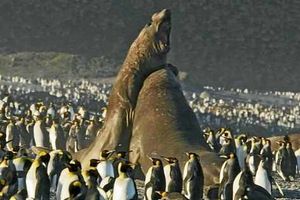
Gentoo penguins dart from the depths, followed swiftly by sealions – the clever predators using tidal currents to propel themselves at the abundant prey.
Feeding in the oceans, penguins are joined by a variety of whales, including the killer variety. Killer whales are filmed working as a team to trap seals, isolating them before 'the kill'.
Yet again, the scenery stole the show. Stunning ice caves with crystal structures, wind-eroded mountains and desolate dry valleys presented a world alien to us.
This footage would have been impossible to realise when Sir David began his odyssey all those years ago. Thankfully, for us, the lucky viewers, technology has changed. We should be equally grateful that its narrator and presenter remains very much the same.