Shropshire businesses' fears over Living Wage
For workers around the country it means extra cash in their pockets - and for the Government, more money swilling around the economy.
But businesses are concerned about the imminent arrival of the National Living Wage.
Currently, the government's national minimum wage is £6.70 per hour, but the National Living Wage for over-25s of £7.20 comes into effect on Friday.
Ray Hickinbottom, chairman of the Federation of Small Businesses in Shropshire, said while he welcomed in principle the higher starting pay, it was being introduced at the same time as new auto-enrolment pensions for many small businesses, which see employers paying into staff's schemes.
"We feel that the Chancellor's timing of it was wrong, with auto-enrolment coming in at the same time," he said.
"It's adding double costs to businesses, at a time when our surveys show confidence among small businesses is low.
"Because it was announced last July it has given people some time to respond to it, but we have had members saying it has put them off employing more people."
The new rules also decree that 21 to 25 year-olds are paid £6.70 per hour, those aged 18 to 20 £5.30, under-18s £3.87, and apprentices £3.30.
The Government is targeting setting the so-called Living Wage at £9 per hour by 2020.
"Many businesses remain unaware of the transitional deadlines and new penalties now in place," warned Tracey Worthington, head of employment law at solicitors FBC Manby Bowdler, which has offices in Telford, Shrewsbury and Bridgnorth.
"Implementing the National Living Wage for eligible over 25s is not something that should be ignored or delayed, as there are stiff penalties in place. Employers can be fined 200 per cent of the amount owed if arrears are not paid within 14 days and receive fines of up to £20,000 per worker."
One sector that is likely to feel the impact of the increased pay scales keenly is agriculture.
Many businesses are already creaking at the seams because of the low prices being paid at the farm gate, with the dairy industry under particular pressure.
Bridgnorth-based Richard Yates, chairman of the National Farmers Union in Shropshire, said: "At the current juncture almost every sector of agriculture in Britain faces uncertain times.
"We value our staff, have good relationships, and hopefully they will continue, but farmers' incomes are heading one way at the moment. Finding extra cash will be hard to do for many people.
"Some farmers will scratch their heads and wonder where they go. Many farmers, particularly dairy farmers, are in negative income."
Animal welfare, he said, remained a priority, but he added that many dairy farmers would contemplate carrying out more roles on farms themselves.
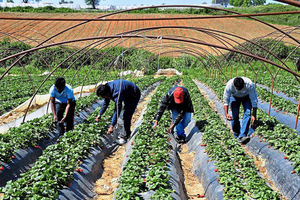
But it is in horticulture, where pickers are more commonplace in the fields, that the greatest increase in costs could arrive.
"A large proportion of their costs are on labour," Mr Yates said. "I do know the largest asparagus grower in the country, who has 1,000 staff.
"If we were to see a lift in our prices then we would be able to absorb this extra cost quite easily, but at the moment it will be a nail in the coffin for some producers." Mr Hickinbottom added that he could see employers reducing their fixed-hours contracts in a bid to ensure the new wage levels are affordable.
"I hope it doesn't, but it could lead to a rise in zero-hours contracts," he said. "There's a place for them, but we don't think it's the solution to the unemployment problem.
"It breeds so much uncertainty for employees."
He added: "We think anything that's going to improve the standards of living for employees will lead to a more settled staff, which in turn leads to better production.
"A happy employee will always work better than a disgruntled one."
The new rate of pay remains below the Living Wage, however, which is an hourly rate of pay calculated to cover the basic cost of living in the UK. It is assessed by the independent action group Living Wage Foundation and most recently has been calculated at £8.25 per hour, or £9.40 per hour in London.
Chris Radford, chairman of the Midlands branch of the insolvency trade body R3, added: "While R3 recognises the valuable principles behind these new wage laws, it is important for local businesses to consider their longer term repercussions on cash flow.
"For example, rises in remuneration for the lowest-paid workers could cause a domino effect throughout the workforce as other employees demand a similar wage increase.
"If cash flow starts to become a major issue, employers should seek professional advice.
The earlier a business recognises severe financial challenges, the more there is that can be done to aid recovery and maintain operational health."
By Business Editor Thom Kennedy