Trump rules out talks with Iran as Israel strikes Lebanon
The US president said he would only accept Iran’s ‘unconditional surrender’.
US President Donald Trump appeared to rule out talks with Iran other than its “unconditional surrender”.
Israeli warplanes pounded Beirut and Tehran on Friday as Iran launched another wave of retaliatory strikes against Israel and Gulf countries on the seventh day of the war.

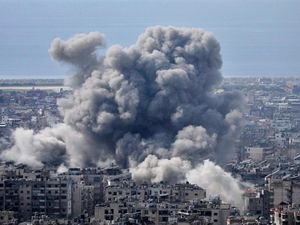
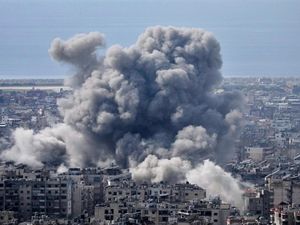
The strikes in Lebanon were the heaviest since a 2024 ceasefire ended the last war between Israel and the Iran-backed Hezbollah, who fired rockets at Israel in the opening days of the latest conflict.
More than 95,000 people have fled Beirut’s suburbs and southern Lebanon after sweeping Israeli evacuation warnings.
The US and Israel have battered Iran with strikes, targeting their military capabilities, leadership and nuclear programme.
The stated goals and timelines for the war have repeatedly shifted, as the US has at times suggested it seeks to topple Iran’s government or elevate new leadership from within.
Meanwhile, Russia has provided Iran with information that could help Tehran strike the US military, according to two officials familiar with US intelligence on the matter.
Russian President Vladimir Putin had a call on Friday with Iranian president Masoud Pezeshkian, expressing his condolences over the killing of Iranian Supreme Leader Ayatollah Ali Khamenei, the Kremlin said.
In a social media post on Friday, Mr Trump said that after Iran’s surrender, “and the selection of a GREAT & ACCEPTABLE Leader(s)”, the US and its allies would help rebuild Iran, making it “economically bigger, better, and stronger than ever before”.
The war has escalated to affect more than a dozen countries across the Middle East and beyond, and has caused a spike in oil prices.
Qatar’s energy minister warned that it could “bring down the economies of the world”, predicting a widespread shutdown of Gulf energy exports that could send oil to 150 dollars (£113) a barrel.
Saad al-Kaabi told the Financial Times that even if the war ended immediately, it could take “weeks to months” to resume normal exports after an Iranian drone strike on Qatar’s largest liquefied natural gas plant earlier in the war.
Mr Trump’s latest comments were likely to raise further questions about the endgame of the war launched a week ago by the United States and Israel, which appears increasingly open-ended.
On Thursday, the president urged the Iranian people to “help take back your country”, promising the US would grant them “immunity”, without elaborating.
He also told media outlets that he should be involved in choosing Iran’s new supreme leader to replace Ayatollah Ali Khamenei, who was killed in the opening strikes of the war.

Mr Trump spoke dismissively of Mr Khamenei’s son, Mojtaba Khamenei — a front-runner to replace his father — calling him “a lightweight”.
Iranian state television has reported that a leadership council has started discussing how to convene the country’s Assembly of Experts, which will select the new supreme leader.
Buildings associated with the 88-member clerical panel have been attacked during the Israeli-US airstrike campaign.
Israel has said it would target the next supreme leader if he poses a threat.
Israel’s military said Friday it had launched “a broad-scale wave of strikes” on Tehran, Iran’s capital, and that over the past week it has heavily bombed an extensive underground bunker that Iran’s leaders had planned to use during the hostilities.

Witnesses described Israeli airstrikes as particularly intense, shaking homes in the area. Others reported explosions around the Iranian city of Kermanshah in an area that is home to multiple missile bases.
Iran, meanwhile, launched missile and drone attacks at Israel, as well as Kuwait, Qatar, Saudi Arabia and Bahrain, all countries that host US forces. There were no immediate reports of casualties.
Qatar said it intercepted a drone attack targeting Al Udeid Air Base, which hosts the forward headquarters of the US central command.
Saudi Arabia said it intercepted and destroyed three ballistic missiles fired towards Prince Sultan Air Base south of Riyadh, which also hosts US forces
Air raid sirens sounded in Bahrain, where the Interior Ministry said Iranian strikes targeted two hotels and a residential building. It said there were no casualties.
In Kuwait, where six US soldiers were killed on Sunday, the army said air defences were activated when missile and drone attacks breached its airspace.
The United Arab Emirates said three drones had struck its territory, without elaborating.
The war has killed at least 1,230 people in Iran, more than 120 in Lebanon and around a dozen in Israel, according to officials in those countries.
Iran’s president, Masoud Pezeshkian, said that “some countries” had begun mediation efforts in the conflict, without elaborating.
Also on Friday, the US military said that it struck an Iranian drone carrier, setting it ablaze.
Its central command released black-and-white footage of the burning carrier, though the Iranian military did not immediately acknowledge the attack.
The drone carrier, the IRIS Shahid Bagheri, is a converted container ship with a 180-meter-long runway for drones. According to reports, the vessel can travel up to 22,000 nautical miles without needing to refuel in ports.
Admiral Brad Cooper, head of US central command, described the carrier as “roughly the size of a World War Two aircraft carrier”, and said it was on fire.
Israel carried out at least 11 airstrikes between late Thursday and early Friday, targeting the southern suburbs of Beirut.
Fires broke out near a gas station and two hospitals evacuated patients and staff. No casualties were immediately reported.
Volker Turk, the UN human rights chief, said he was “extremely concerned” about the situation, particularly what he described as “blanket, massive displacement orders” by Israel to civilians in Lebanon.
The Lebanese health ministry said the death toll has risen to 123 since the resurgence of hostilities between Israel and Hezbollah, which struck Israel in the opening days of the war.
Hezbollah’s military command on Friday urged its fighters not to relent and to “defend the nation”, casting the escalating war in religious terms and calling on them to “kill them wherever you find them”.
Lebanon’s Prime Minister Nawaf Salam slammed both Israel and Hezbollah, saying the Lebanese state and people “did not choose this war”.