Irish foreign minister pressed on whether US and Israel broke international law
Helen McEntee was asked repeatedly if the two countries broke international law when they targeted Iran at the weekend.
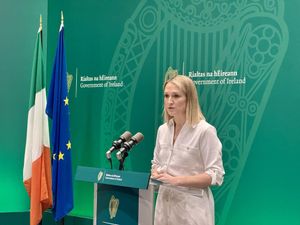
The Irish Minister for Foreign Affairs has repeatedly refused to say if she believes Israeli and American air strikes on Iran broke international law.
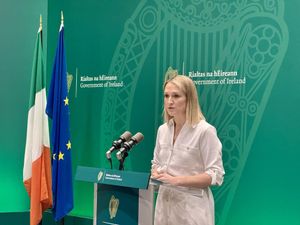
Speaking to the media in Dublin on Thursday afternoon, Helen McEntee was asked several times if actions by the two countries were outside international law.
She referred repeatedly to the lack of a mandate from the UN, saying in order for conflicts to be “justified” there “needs to be a UN mandate from the UN Security Council”.
On Saturday, the US and Israel targeted Iran’s leadership, missile arsenal and nuclear programme in a series of air strikes.
Iran retaliated with thousands of drones and ballistic missiles targeting Israel, UK and American military bases and embassies in the region, and energy facilities across the Persian Gulf.
The war has killed more than 1,230 people in Iran, more than 100 in Lebanon and around a dozen in Israel, according to officials in those countries.
It has disrupted the supply of the world’s oil and gas, snarled international shipping and stranded hundreds of thousands of travellers in the Middle East.
Asked why she was stopping short of explicitly saying the Irish government believes Israel and the US broke international law Ms McEntee said much of the “extremely difficult situation in the Middle East” was “caused by Iran”.

She said: “I think we’re all grappling with the fact that Iran has not only subdued and massacred its own citizens and population in recent decades and more recently, in recent weeks, but it has essentially contributed to state-sponsored terrorism for many in the region.”
She added: “So much of the instability and conflict that has been caused in the region has been at the hands of Iran.
“So we all want to see an improvement and a change, and we want the people of Iran to be able to essentially set out their own destiny.”
Ms McEntee also defended the 800 euro cost of tickets for an Irish government charter jet, which is due to leave Oman for Dublin tomorrow.
The price is “in line with any other type of scenario like this”, she said and is “less than half of the cost of the overall flight per person”.
She added that children under 16 will fly for free and transport from the UAE to Muscat in Oman, where the flight will depart from, will also be free.
But, she said: “The cost will never be a reason why somebody cannot get home in this instance, and if people have an issue or concern, the consular team are dealing and engaging with them directly.”
The consular office, which was set up to help Irish people caught up in the conflict, has had 2,300 contacts since the weekend, she said, but added some of those are “duplicate” calls.
Ms McEntee said she “hoped” the flight would be able to accommodate “more than 280 people”.
She said the consular team have been getting in touch with those deemed “most at risk”, those with young children at home and those in transit to offer them places on the flight.
Ms McEntee said up to “half of those contacted” about travelling on the charter flight have “decided to wait and see whether or not they can get a commercial flight home”.
She said that was understandable given it “is a lengthier journey to Oman”.
The charter flight, along with further commercial flights that she “expects and anticipates in the coming days”, will mean “we will see hundreds, if not above the thousand number, getting into Dublin before the end of the week”.
Speaking about the first commercial flight that landed in Dublin on Wednesday night, Ms McEntee said it was her “understanding” that around 80% of the passengers were Irish.