Reeves reaffirms commitment to end windfall tax in talks with North Sea bosses
The Chancellor met figures from BP, TotalEnergies and Serica in Downing Street.
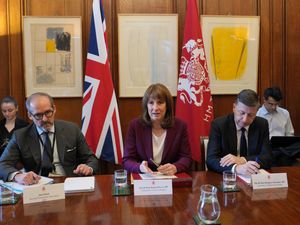
Rachel Reeves reaffirmed her commitment to end the windfall tax on North Sea oil and gas as she met energy bosses, while warning that the Middle East war has created a “more uncertain context for policy decisions”.
The Chancellor discussed the gas and oil prices sent soaring by Iran’s threats to block a key shipping route in talks with firms including BP, Adura and Offshore Energies UK.
Ms Reeves came under pressure ahead of the Downing Street discussions from Scottish First Minister John Swinney to axe the charge, which is officially known as the energy profits levy.

Introduced by the Tory government in the wake of the war in Ukraine – which sparked a sharp rise in energy prices – the charge was brought in to claw back some of these unexpected profits for the Treasury.
After the talks, a Government source said: “The Chancellor was clear with industry that she wants the energy profits levy to come to an end.
“She has made that promise and she stands by it. Indeed, it was a commitment she wanted to make this week.
“But the crisis in the Middle East has had real-time consequences on oil and gas prices and it is right that we respond to this.”
The Treasury said Ms Reeves told the bosses that the expected triggering of the energy security investment mechanism in 2027 – which will end the windfall tax – “will be welcome and emphasised her keenness to provide certainty to the sector on that front, but she highlighted that geopolitical events create a more uncertain context for policy decisions”.
The department described the talks as “positive,” with ministers working with the sector to provide long-term financial certainty and to navigate the uncertain period over the coming months.
Earlier, Mr Swinney again insisted it was “utterly essential” the UK Government scraps the windfall tax, which he said was impacting investment in the North Sea and costing jobs.
He said the current “uncertainty over energy supplies” as a result of the conflict in the Middle East was now a “material consideration” for the scrapping of the charge.

Speaking during a visit to Inverness, Mr Swinney said he had hoped the Chancellor would use Tuesday’s spring statement to axe it.
When that did not happen, Holyrood’s Finance Secretary Shona Robison said Ms Reeves must use Wednesday’s meeting with North Sea industry leaders to “announce an end to this tax on Scotland’s energy”.
Mr Swinney meanwhile insisted: “Now that we have the conflict in the Middle East, I think it is utterly essential that the energy profits levy is removed.
“I had hoped it would be removed yesterday in the spring statement. It hasn’t been but the Chancellor is meeting the industry today.
“I hope that results in the removal of the energy profits levy.”
Mr Swinney, speaking to the Press Association, added: “I’ve been saying to the UK Government for some time that the energy profits levy should be removed because it is hampering investment in the North Sea oil and gas sector, which is resulting in a loss of employment at a much faster rate than we anticipated.”
With the conflict in the Middle East leading to “uncertainty over energy supplies in the period to come” the First Minister said that was now a “material consideration in whether the energy profits levy should be maintained”.
He insisted however: “I don’t think there is a case for it and it should be removed.”
But Simon Francis, co-ordinator of the End Fuel Poverty Coalition, said: “Conflict in the Middle East and rising global gas prices show exactly why the windfall tax remains necessary, not why it should be scrapped. When geopolitical tensions push up prices, energy companies and their shareholders benefit while households face another round of higher bills from July 1.
“Energy firms have made tens of billions in profits in recent years even with the energy profits levy in place, so the idea that removing it will suddenly make energy cheaper or more secure simply doesn’t stand up.
“The North Sea is declining because of the geology of an ageing basin, not because companies are paying a fair share of tax.
“Instead of handing the industry a tax break, governments should be using these revenues to cut bills, tackle energy debt, support workers through the transition and invest in warm homes and clean energy so households are protected from exactly this kind of global price shock.”
Meanwhile, Energy Secretary Ed Miliband rejected calls for the Government to reverse its ban on new licences for North Sea drilling.
He wrote on X: “The Government continues to monitor the situation in oil and gas markets and work with our international partners. In recent days I have been in contact with a number of international colleagues including the Qatari and Saudi Energy Ministers, the IEA (International Energy Agency), and key industry figures.
“Conflict in the Middle East is yet another reminder that the only route to energy security and sovereignty for the UK is to get off our dependence on fossil fuel markets, whose prices we do not control, and on to clean homegrown power we do.”
He hit out at Tory leader Kemi Badenoch’s argument that new North Sea exploration licences could cut bills, noting they “won’t take a penny off bills” because “oil and gas is sold on international markets”.
Russell Borthwick, chief executive of the Aberdeen & Grampian Chamber of Commerce, said events in the Middle East “strengthen, not weaken, the case for change” on the levy.
He said: “The offer on the table was billions of pounds worth of investment, which can be unlocked overnight if the right fiscal and regulatory conditions are in place.
“For the thousands of companies and tens of thousands of workers who depend on the UK oil and gas industry, that investment would support jobs, strengthen supply chains and reinforce the UK’s energy security at a time of growing global uncertainty.
“There has never been a more important, more urgent moment to back the North Sea and invest in domestic production.
“It is now incumbent upon the Chancellor to create the fiscal and regulatory environment which would allow these companies to invest.
“The energy profits levy has left the UK exporting jobs and importing oil and gas from volatile regions.
“Moving to the Oil and Gas Price Mechanism can change that trajectory, but it’s up to the UK Government to act now.”