
Bank of England holds interest rates but future cuts ‘likely’
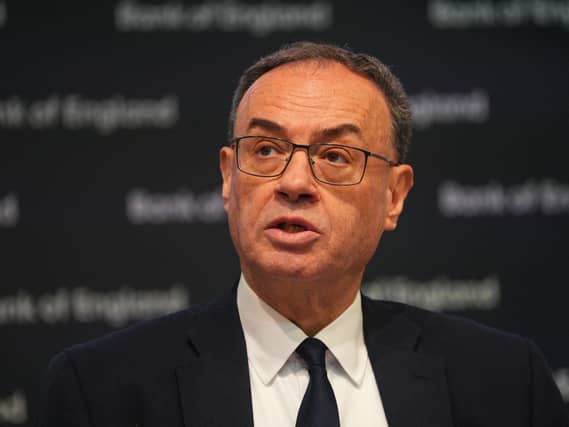

It came as the central bank also warned that economic growth is now set to be weaker than previously expected.
The Bank of England has said future interest rate cuts are “likely” amid a slowdown in inflation, despite policymakers voting to hold rates at 3.75% on Thursday.
It came as the central bank also warned that economic growth is now set to be weaker than previously expected while unemployment is on track to jump higher.
A five-to-four majority of the Bank’s Monetary Policy Committee (MPC) opted to keep rates unchanged at 3.75%, two months after they were cut from 4% in its previous meeting.
In their report alongside the decision, Bank rate-setters said it is currently “likely” that interest rates will be cut further.
Governor Andrew Bailey, who was among those who voted to maintain rates, said: “All going well, there should be scope for some further reduction in the bank rate this year.”
Economists said after the tight vote that it has increased the likelihood that interest rates will be cut next month.
On Thursday, the central bank said it was keeping rates unchanged to make sure that inflation stays around its target level of 2%.
New forecasts from the Bank show the rate of Consumer Prices Index (CPI) inflation dropping to the target this year, having previously said this would happen in 2027.
The MPC thinks that measures announced in the Chancellor’s autumn budget will help to slow inflation, particularly a package of support to bring down household energy bills from April.
Central banks typically use elevated interest rates to bring down inflation but reduce them if inflation is dropping too quickly or there is a need to stimulate further economic growth.
The Bank has cut interest rates six times over the past 18 months after rates peaked at 5.25%.
Experts at ING are predicting that the Bank will cut rates again in March and June to bring the level to 3.25%.
James Smith, developed markets economist at ING, said: “Everything comes down to Governor Bailey’s vote in March.
“Our sense is that if the data follows recent trends – higher unemployment/falling payrolls, slower wage growth – then he will swing behind a cut next month.”
Matt Swannell, chief economic adviser to the EY Item Club, said the vote in the rates decision was closer than expected, increasing the chances of a rate cut as soon as next month.
He said: “The latest assessments by most committee members suggest that they’ve become less concerned about sticky wage and price pressures at the start of the year, and more focused on the subdued growth outlook and the potential downside knock-on effect for the jobs market.
“There were no promises made on when the Bank of England may cut rates again, but such a closely balanced vote split clearly opens the door to a rate cut at the March meeting.”
Inflation was most recently recorded at 3.4% in December but is set to drop more quickly from April, partly due to the impact of new energy bills support from the budget, which is set to reduce the typical annual household energy bill by £134.
Measures linked to the budget will contribute to a roughly 0.5 percentage point drop in the inflation rate.
Bank officials have also highlighted that slowing wage growth will contribute to the drop in inflation.
The inflation rate is set to remain close to the 2% target through to the end of 2026, but is then set to dip as low as 1.7% in early 2027.
Meanwhile, the Bank’s latest forecasts presented a gloomier picture for UK growth.
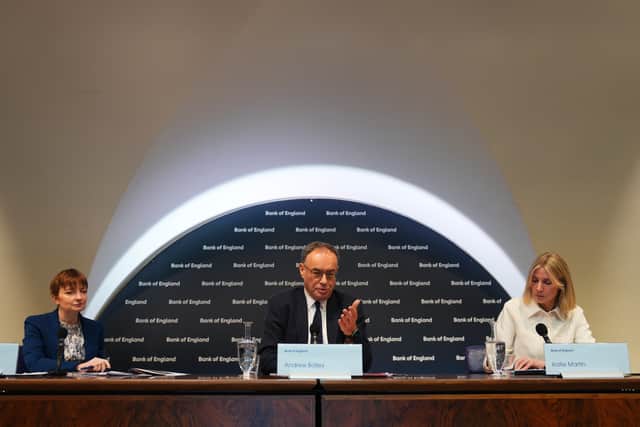
It showed that it believes the UK economy grew by 1.4% in 2025, having last predicted growth of 1.5% for the year.
It also downgraded its gross domestic product (GDP) forecasts for 2026, to 0.9% from 1.2%, and 2027, to 1.5% from 1.6%.
Growth is, however, expected to lift above previous guidance to 1.9% in 2028.
Officials from the Bank found that consumer demand for goods and services has been subdued, and is expected to remain so “through 2026”, with firms citing rising unemployment and continued concerns over the cost of living.
Supermarkets told the Bank they have seen “modest” volume growth, with consumers cautious about their overall spending and therefore “forgoing treats”.
The Bank’s report highlighted that growth was also dampened by wider pressures in the UK labour market.
In November, the Bank predicted that unemployment would peak at 5.1%. But on Thursday, it said this is now expected to rise as high as 5.3%.
The unemployment rate is then expected to steadily decline to 5.2% in 2027 and 5.1% in 2028.
It had previously forecast rates of 5% and 4.8% for 2027 and 2028 respectively.