
Three killed in Stonehaven derailment suffered ‘unsurvivable injuries’ – inquiry
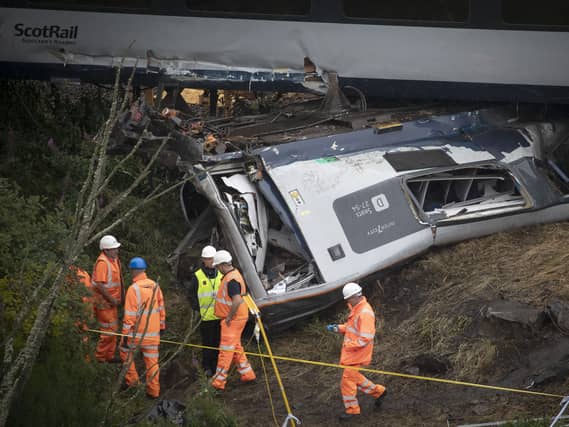

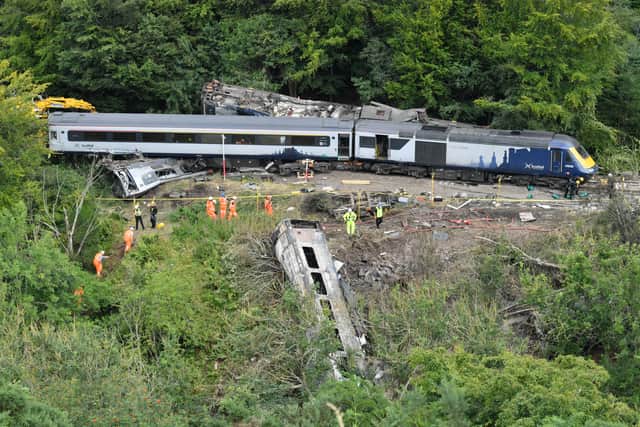
The crash in Aberdeenshire on August 12 2020 claimed the lives of three people and resulted in six others being injured.
Three men killed in the derailment of a train in Aberdeenshire after it hit debris washed onto the track by heavy rainfall suffered unsurvivable injuries, a fatal accident inquiry (FAI) has been told.
The crash at Carmont near Stonehaven on August 12 2020 resulted in the deaths of train driver Brett McCullough, 45; conductor Donald Dinnie, 58; and passenger Christopher Stuchbury, 62; and six people were injured.
The FAI, which began at Aberdeen Sheriff Court on Monday, heard Mr Stuchbury was “thrown clear of the train” by the derailment, while the body of Mr McCullough was found on the lower part of the embankment where the carriage vehicles had scattered after striking a bridge parapet.
Mr Dinnie’s body was stuck in the doorway of coach D and could not be retrieved until August 13, the inquiry was told.
Alex Prentice KC, Crown counsel for the inquiry, said post-mortem examinations showed the three men suffered multiple blunt force injuries in the derailment.
“It was judged that these injuries were non-survivable and death would likely have been immediate,” Mr Prentice, reading out the joint minute, told the court.
Six other people were injured in the accident, including a 29-year-old American student at Aberdeen University who had to be airlifted to the hospital.
Mr Prentice read out parts of a statement written by Diane Stuchbury, Mr Stuchbury’s wife, who told the court her husband died on their wedding anniversary.
Her statement read: “Every day with Chris was a gift.
“The most loving, kind, wise, and loyal man you could ever wish to meet.
“The 12th of August used to be a special day in our house: the day we married.”
Mrs Stuchbury said the accident that claimed her husband’s life “should have never happened”, adding they “have been robbed of their future together as a couple.”
Mr Dinnie’s family said in their statement: “He was loved and adored by all his family and friends. He will be forever missed.”
Emergency crews who attended the crash site on the morning of August 12 2020 were confronted with a “highly complex incident”, with two firefighters becoming injured during the course of the operation, the FAI further heard.
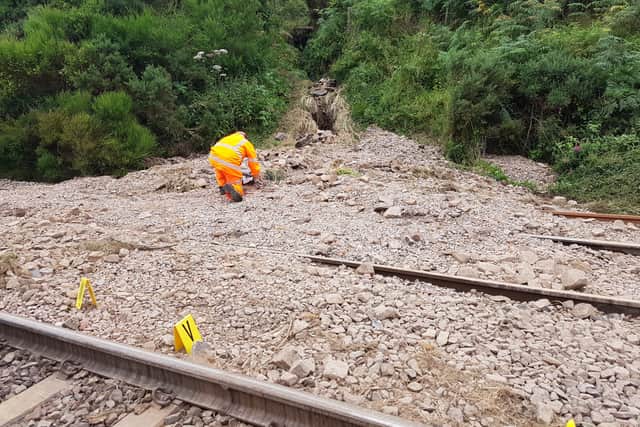
Nick Bucknall, an inspector of rail accidents with the Rail Accident Investigation Branch (RAIB), told the inquiry the passenger train collided with “debris washed from a drain onto the track near Carmont, Aberdeenshire, following very heavy rainfall” at about 9.37am.
The train was travelling at 73mph at the time of the crash.
“The drainage system was unable to accommodate the flow of surface water,” Mr Bucknall, summarising the factors that led to the derailment, told the inquiry.
“The gravel in the drainage trench was vulnerable to washout.
“Network Rail did not have arrangements for additional operational mitigation.
“The speed of train 1T080 was not restricted.”
A criminal prosecution saw Network Rail fined £6.7 million in 2023 after it admitted health and safety failings over the crash, which happened on a day of torrential rain.
An RAIB report published in March 2022 found errors in the construction of a drainage system installed by Carillion meant it was unable to cope with heavy rain which fell in the area on the morning of the crash.
Carillion went into compulsory liquidation in January 2018.
The RAIB report made 20 recommendations to improve railway safety, many of which were directed at Network Rail.
A Network Rail spokesperson said on Monday: “The tragic accident at Carmont was a terrible day for our railway, and our thoughts remain with the families and loved ones of train driver Brett McCullough, conductor Donald Dinnie and passenger Christoper Stuchbury, along with all those affected by the derailment.
“The Rail Accident Investigation Branch (RAIB) report into Carmont made clear that there were fundamental lessons to be learnt by Network Rail and since August 2020 we’ve been working hard to make our railway safer for our passengers and colleagues.
“We’re committed to supporting the work of the inquiry and continuing to deliver on the recommendations made by RAIB.
“We’ve made significant changes to how we manage the risk of severe weather since the accident and our work to make our network more resilient will continue.”
The FAI is expected to continue until February 13, resuming on February 23 for a final week.