Government open to law change amid calls to proscribe Iranian military branch
Peter Kyle said ministers were committed to supporting the country’s citizens as they face brutal government suppression.
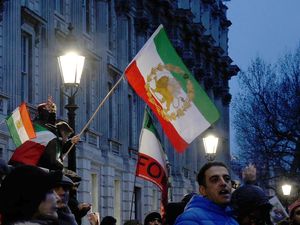
The Government is willing to consider making changes to UK terror law that would enable it to ban the Islamic Revolutionary Guard Corps (IRGC), a minister has said.
Trade Secretary Peter Kyle admitted that proscribing the Iranian military branch would not be “appropriate” under existing domestic legislation but that ministers were committed to supporting the country’s citizens as they face brutal government suppression.
Hundreds of people have been killed and thousands detained in the uprising against Supreme Leader Ayatollah Ali Khamenei’s rule, prompting renewed calls for the UK Government to proscribe the IRGC.
Speaking to broadcasters on Monday, Mr Kyle cited a review by the UK’s independent reviewer of terror legislation Jonathan Hall KC last year which he said found that proscribing a foreign state body like the IRGC would not be “appropriate” under domestic law.
But he told LBC: “He (Mr Hall) might well be making recommendations of how we change the law, but these are things that we will look at going forward.”
The Trade Secretary said the Government had already used sanctions against Iran “to the full extent we can” and insisted Sir Keir Starmer was working with partners to see how “we can bring international pressure to bear” on the country’s government.
“It is no question and I don’t think anybody would question the fact that this Government cares very deeply about civilians and people in Iran. We will do everything we can, but when we use domestic legislation we need to make sure that it’s appropriate use of it,” he told Times Radio.
Asked whether Britain would support the US if it decided to strike Iran, Mr Kyle told Sky News: “Well there’s a lot of ifs in the question itself, so we have to see how this unfolds.
“We need to understand specifically what Donald Trump and America is proposing.”
He said “the people of Iran should get the Government they choose and the Government of Iran should not, in any way, be cracking down in a murderous way which we’ve seen so far”.
Mr Kyle added: “This is about us supporting people of Iran in their time of need so that the people of Iran can have their voices heard and be the masters of their own destiny.”

US President Donald Trump said on Sunday night that “Iran wants to negotiate” after he threatened action following the crackdown, but did not rule out a response.
“I think they’re tired of being beat up by the United States,” he told reporters after saying Iran had proposed negotiations and his administration was in talks about a meeting.
Over the weekend, demonstrators gathered outside Downing Street to call for the IRGC to be banned as a terrorist organisation – a call which has support from senior figures in Parliament including Labour peer Lord Spellar and former Tory leader Sir Iain Duncan Smith.
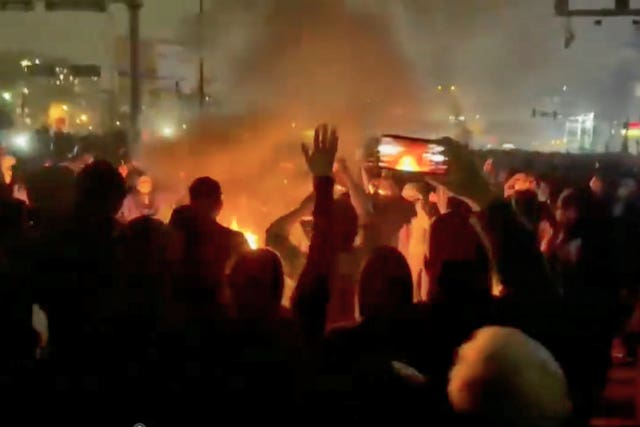
Protests in Iran began on December 28 over the ailing economy and have transformed into the most significant challenge to the regime for several years.
The internet and telephone lines have been cut off, but footage of events in Tehran and other cities has made it to social media.
The US-based Human Rights Activists News Agency said the number of confirmed fatalities had risen to at least 544 – 496 protesters and 48 members of security forces.
More than 10,000 people have been detained during the two weeks of protest.