Palestine Action ban would be ‘authoritarian abuse’ of power, High Court told
The ban is set to come into force at midnight unless the legal bid for a temporary block is successful.
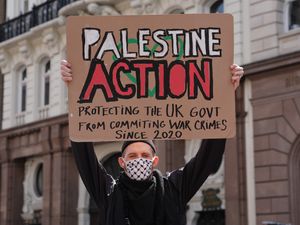
Banning Palestine Action as a terror group would be “ill-considered” and an “authoritarian abuse” of power, the High Court has been told.
Huda Ammori, the co-founder of Palestine Action, is asking the High Court to temporarily block the Government from banning the group as a terrorist organisation before a potential legal challenge against the decision to proscribe it under the Terrorism Act 2000.
The move is set to come into force at midnight after being approved by both the House of Commons and the House of Lords earlier this week, and would make membership and support for the direct action group a criminal offence punishable by up to 14 years in prison.
The Home Office is opposing bids to delay the ban from becoming law, and the potential launch of a legal challenge against the decision.
At a hearing on Friday, Raza Husain KC, for Ms Ammori, told the London court: “This is the first time in our history that a direct action civil disobedience group, which does not advocate for violence, has been sought to be proscribed as terrorists.”
The barrister said that his client had been “inspired” by a long history of direct action in the UK, “from the suffragettes, to anti-apartheid activists, to Iraq war activists”.
Quoting Ms Ammori, the barrister continued that the group had “never encouraged harm to any person at all” and that its goal “is to put ourselves in the way of the military machine”.

He continued: “We ask you, in the first instance, to suspend until July 21 what we say is an ill-considered, discriminatory and authoritarian abuse of statutory power which is alien to the basic tradition of the common law and is contrary to the Human Rights Act.”
The barrister later said that the Home Office “has still not sufficiently articulated or evidenced a national security reason that proscription should be brought into effect now”.
He added: “The discretion to proscribe an organisation must be exercised with respect to the central concern of the Act, which plainly is not to simply proscribe any organisation which fits the definition.”
Mr Husain later said that to proscribe an organisation, the Home Secretary “has got to believe that the organisation is concerned in terrorism”.
“If you get isolated conduct associated with Palestine Action that meets the statutory definition, that is not enough because you have got to look at the organisation as a whole,” he said.
Blinne Ni Ghralaigh KC, also representing Ms Ammori, told the court that if the ban came into effect the harm would be “far-reaching”, could cause “irreparable harm to large numbers of members of the public”, including causing some to “self-censor”.
The barrister named Normal People author Sally Rooney, who lives abroad and “fears the ramifications for her, for her work, for her books, for her programmes” if she shows support for Palestine Action.
“Is the Prime Minister going to denounce her, an Irish artist, as a supporter of a proscribed organisation?”
“Will that have ramifications for her with the BBC, etc?” Ms Ghralaigh asked.
Mr Justice Chamberlain previously said that if he decided to temporarily block the ban, he could do that with either an “interim declaration” or by making an injunction “requiring the Secretary of State to make an order”.
Ben Watson KC, for the Home Office, told the High Court there was an “insuperable hurdle” in the bid to temporarily block the ban of Palestine Action.
The barrister also said that if a temporary block was granted, it would be a “serious disfigurement of the statutory regime”.
He said Palestine Action could challenge the Home Secretary’s decision at the Proscribed Organisations Appeal Commission (POAC), a specialist tribunal, rather than at the High Court.
Mr Watson said: “At its heart, it is a challenge to the proscription of the organisation … POAC is the forum of first resort.”
He continued: “Even if the court does conclude that there is some residual scope for judicial review … then we respectfully submit that the court needs to look at the bespoke regime that Parliament has provided.”

Friday’s hearing comes after an estimated £7 million worth of damage was caused to two Voyager planes at RAF Brize Norton on June 20, in an action claimed by Palestine Action.
The Home Secretary, Yvette Cooper, announced plans to proscribe Palestine Action on June 23, stating that the vandalism of the two planes was “disgraceful” and that the group had a “long history of unacceptable criminal damage”.
Mr Justice Chamberlain said that an assessment on whether to ban the group had been made as early as March, and “preceded” the incident at RAF Brize Norton.
He said: “The process or assessment on the basis of which that proscription decision was made preceded that, in March.”
Police said that the incident caused around £7 million worth of damage, with four people charged in connection with the incident.
Amy Gardiner-Gibson, 29, Jony Cink, 24, Daniel Jeronymides-Norie, 36, and Lewis Chiaramello, 22, are accused of conspiracy to enter a prohibited place knowingly for a purpose prejudicial to the safety or interests of the United Kingdom, and conspiracy to commit criminal damage.
They were remanded into custody after appearing at Westminster Magistrates’ Court and will appear at the Old Bailey on July 18.
The hearing before Mr Justice Chamberlain will conclude later on Friday, with the High Court judge expected to give his decision at the end of the hearing.
A further hearing to decide whether Ms Ammori will be given the green light to challenge the decision to ban Palestine Action is expected to be heard later this month.