In a Flash: Former Wolves and Manchester United player's journey from football to academia
Successive away trips to Liverpool and Manchester United offers, especially with Wolves’ current predicament, a sobering reminder of the challenges of the Premier League. For Richard Flash, being scouted by clubs of that calibre was once the norm. The footballer-turned-academic talks to PAUL BERRY.
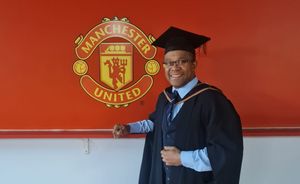
A conversation with Richard Flash feels a bit like taking a journey through a footballing Who’s Who of the 1990s.
He once lived and roomed with David Beckham. Was praised by Paul Scholes and Gary Neville. Is in contact with his footballing heroes Bryan Robson and John Barnes. Was once challenged by Sir Alex Ferguson to become the next Ryan Giggs. Was signed twice, including for Wolves, by Graham Taylor.
He may not be a household name. But he most certainly could have been.
Without a luckless series of injuries, and the associated physical and psychological effects, life could have been very different. With a fairer wind Flash could have become one of Fergie’s fledglings who lit up the Premier League at Old Trafford.
But there is no bitterness or regret. Just positive reflections on how the various experiences he enjoyed, and people he met, have given him the ammunition to take forward.
Now a lecturer in sports business and management at the University Campus of Football Business (UFCB) in Manchester, Flash’s research interests include English-based footballers of African and Caribbean descent.
And that research, now featuring a website and X account and including compiling a ‘one to 11’ of the first black players to represent different clubs, has refreshed and reignited and his passion for the game.
“I’d say I had some difficult times in football, and probably fell out of love a little bit, but with the research it’s all coming back now,” says Flash, now 49.
“I’m getting the feelings back like when I was a kid, back home in Birmingham, supporting Villa with Gary Shaw, Peter Withe, Tony Morley and the rest.
“I remember them winning the European Cup when I was eight years old, and then my brother taking me to Villa Park for the first time to see them play. It’s like reliving my childhood!
“Now, alongside my work as a lecturer, I have the opportunity to raise awareness and educate on the experiences of black players, where they have come from and what they have achieved.
“Asking those players what they did to overcome the barriers they experienced, how they overcame racism, and using the contacts I made from football to build those conversations.
“In my spare time, this is what I am doing, and what I can see really developing over the next decade or so.”
More on that research later. But what of Flash the footballer? And indeed, Flash the Wolves player?
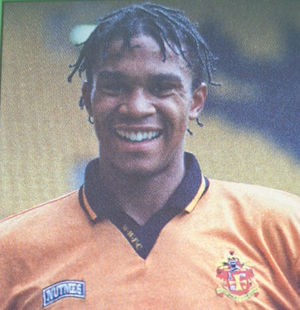
It was Taylor who signed him in the summer of 1995, as he headed into his second full season at the helm at Molineux. And would later sign him for Watford.
And that stemmed from having seen him as a young player training with Villa as a teenager.
Getting into football via support from his mother, Flash excelled playing for schools in inner city Birmingham and also in local five-a-side competitions, soon leading to being scouted by, and training with, both Villa and Birmingham City.
As a developing player, Flash had the lot. A box-to-box midfielder with plenty of skill and an eye for goal, he enjoyed playing football, but wasn’t overly fussed about pinning his colours to a club.
Liverpool, Manchester United, Arsenal, Tottenham, Nottingham Forest. They were all tracking Flash’s progress. But in the back of his mind, he was also considering another career, maybe in business or accountancy. Football wasn’t the be-all and end-all, along with a natural shyness to his personality that left him happy to settle in surroundings which were the most comfortable.
It was Manchester United’s Midlands’ scout Geoff Watson who ultimately made the breakthrough. He spoke to Flash’s mother, and didn’t put on any pressure, offering the opportunity to train with United in the holidays, and play for their feeder team in the Midlands, Manchester Eagles.
While he still wasn’t massively keen to put pen to paper on schoolboy forms, even with a club like United, their boss Ferguson sent Lee Sharpe to his school for a TV feature which was also designed to try and tempt him into signing.
“I was in the same age group as people like Michael Appleton, Terry Cooke and David Johnson,” Flash explains.
“We’d go up and train in the school holidays and you might see Fergie or Brian Kidd who would say ‘hi’, and then we’d watch the youth or reserve teams play a game.
“I remember the once sitting with ‘Johnno’ in Sir Alex’s office, when I was probably 14, just the two of us and the manager.
“He was telling us that, in four years’ time, we could be like this player they had at the time called Ryan Wilson – Ryan Giggs of course – Fergie was telling us that we were good enough and had that sort of potential.”