Avoiding mid-pregnancy weight loss boosts lambing outcomes
In a season when forage stocks could be under pressure following the dry summer, sheep farmers should take particular care to ensure ewes maintain body condition score throughout pregnancy.
This is the advice of Rumenco’s Technical Services Manager Dr Alison Bond, who says allowing significant weight loss in the mid-pregnancy period, in particular, could result in reduced lamb birthweights, lower lamb survival rates, and even poorer reproductive performance in future flock replacements.
Prioritising flock nutrition during the second trimester is important, she says, with supplementary feeding being a key consideration if grazing or forage supplies are lacking in either quantity or nutritional quality.
“At one time, it was considered acceptable for ewes to lose up to 0.5 in body condition score during mid-pregnancy, but the most recent research shows otherwise,” she explains. “We now know that the majority of placental growth takes place in these earlier stages of pregnancy and understand far better the vital role this plays in foetal development. If ewes are losing weight at this critical stage, this could lead to sub-optimal placental development and some disruption in the supply of oxygen and nutrients to the foetal lambs. Even at this early stage, a female foetus will be developing ovaries, for example, so the implications could reach as far forward as the future reproductive performance in those unborn lambs.”
Given the importance of avoiding weight loss in mid-pregnancy, Dr Bond says supplementary feeding of ewes will be cost effective if grazing or conserved forage is insufficient to maintain body condition score.
“In an ideal world, well-planned grazing or homegrown forage should provide most of a flock’s requirements,” she adds, “but many areas are suffering a deficit this year. It will be all the more important to closely assess what is available and to have analyses carried out to test protein and energy content as well as the mineral and trace element profile if possible.
“Where there is pressure on supplies, or the quality is not there, it really is vital not to allow this to impact on flock condition.
“It is important to monitor ewes closely and take action before there are any significant signs of weight loss. In circumstances where some level of intervention is required, it is far better to offer a little-and-often feeding solution with molasses-based feed and mineral blocks.
“Trough feeding of concentrates is an option, but it is more labour intensive and will result in a lot of bumping, barging and bullying at feeding time, which is not an ideal scenario for pregnant ewes. Free access blocks are a far more natural way of feeding and can be used to manipulate grazing and ensure better use of forages.”
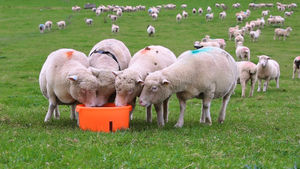
Rumenco’s Rumevite All Season is a high energy and protein feed block ideally suited to supplementing ewes in mid-pregnancy. Its proven formulation is designed to complement lower quality forages by supporting rumen function and stimulating intakes. In addition, the feed block provides essential minerals, vitamins and trace elements that may be lacking in forages.
“The natural protein and urea supplied in these blocks are particularly valuable where lower quality forage is being fed,” says Dr Bond, “whilst good levels of energy from fermentable sources of sugar and starch are there to help maintain ewe condition.”
Overcoming potential deficiencies
Beyond body condition score, it is also important to consider the general health and wellbeing of the ewe, and the impact of this on the unborn lambs, so the inclusion of readily available minerals, vitamins and trace elements is another advantage of feeding blocks.
“The supply of important micronutrients may be particularly important if farms are reliant on bought-in bales of unknown mineral status, or have a predominance of reseeded leys with modern grasses that are typically lower in certain minerals,” adds Dr Bond. “Cobalt, zinc and selenium are examples of the key inclusions in Rumevite blocks that are designed to prevent potential problems resulting from deficiencies.
“Zinc is essential in maintaining internal and external tissue health, so is particularly important, for example, in flocks where there may be a history of lameness. Cobalt, which can be deficient in forages, is important in embryo development in early pregnancy and also has a wider role in the ewe’s immune system. Selenium and vitamin E are another good example of an important inclusion, these also being vital in immune function as well as fertility.
“Providing these important micronutrients, little and often to the whole flock, throughout these critical stages of pregnancy, will help to prevent – or in some cases solve – some of the more common flock problems.”
Rumevite All Season blocks are molasses-based and formulated to be attractive to the ewes, to promote intakes. The recommended feeding rate is one 22.5kg block between 30 to 35 ewes.