Scientists design ‘world’s smallest house’ deemed too tiny for a mite
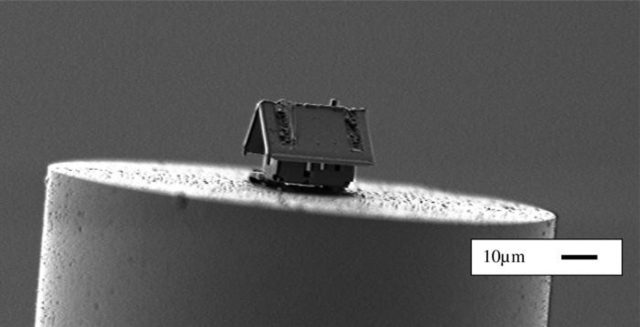
The ‘microhouse’ isn’t visible to the naked eye.
Scientists have designed and built the world’s smallest house – but you won’t be able to see with the naked eye.
Deemed so tiny that a dust mite wouldn’t be able to fit through the door, the “microhouse” measures just five microns (0.005mm).
For comparison, a human hair is around 75 microns thick (0.075mm).
Created by scientists from the Femto-ST Institute in France, the house comes with a front door, windows and a tiled roof.
Study author Dr Jean-Yves Rauch, of the Femto-ST Institute, said: “For the first time we were able to realise patterning and assembly with less than 2 nanometers of accuracy, which is a very important result for the robotics and optical community.”
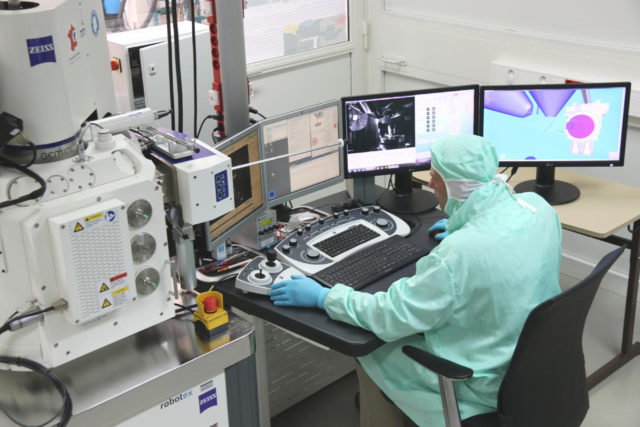
The microhouse was created using a new nanorobotic system called μRobotex, where a focused ion beam was used to “cut” the house template on a silica membrane.
The team liked the process to “making a giant dice from a piece of paper”.
The flat template was then built into a 3D house using a gas injection system to “stick the edges of the structure into place”.
Dr Rauch added: “We decided to build the microhouse on the fibre to show that we are able to realise these microsystem assemblies on top of an optical fibre with high accuracy.”
The researchers say they may eventually be able to build smaller structures on the ends of carbon nanotubes that are just 20 to 100 nanometers in diameter.
“With this advancement, optical fibres as thin as human hair can be inserted into inaccessible locations like jet engines and blood vessels to detect radiation levels or viral molecules,” they added.
The results are published in the Journal of Vacuum Science and Technology A.