Tributes to Shropshire schoolmaster "responsible for the 1960s" and inspired Monty Python sketch who died at 97
Tributes have poured in to a Shrewsbury School master who helped unleash the British satirical boom and was said - only half jokingly - to have been “responsible for the 1960s.”
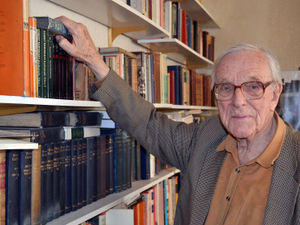
Laurence Le Quesne, who has died aged 97, also had the unusual distinction of being the inspiration for the famous “Knights Who Say Ni” scene in the 1975 movie Monty Python and the Holy Grail.
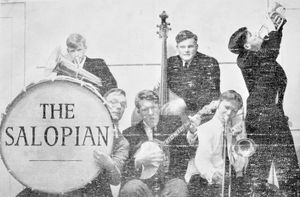
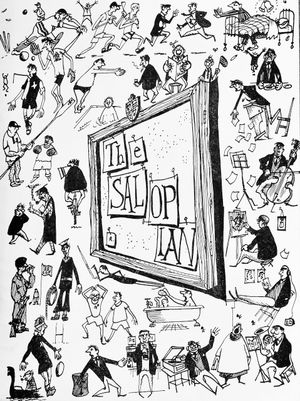
During his time as master in charge of Shrewsbury School’s magazine, The Salopian, his liberal outlook gave creative licence to pupils Willie Rushton, Richard Ingrams, Paul Foot, and Christopher Booker, who in the early to mid-1950s transformed it from staid school magazine fare, adding irreverent and humorous input including Rushton’s cartoons. It proved to be the primordial soup from which the satirical magazine Private Eye emerged in the 1960s with those Old Salopians at the helm.
Mr Le Quesne wrote a number of books, including one about cricket’s great Bodyline controversy, for which he interviewed both Larwood and Bradman.
Shrewsbury's headmaster Leo Winkley said: “Laurence Le Quesne was an unforgettable character and an inspirational teacher. His passion for history and his sharp wit made a lasting impression on generations of Salopians.
"His encouragement of young writers for Shrewsbury's 'The Salopian' helped shape voices that would go on to leave a lasting mark on British satire and journalism.
"Laurence remains a vivid and much-loved figure in the life of the school. We are deeply grateful for the extraordinary contribution he made to Shrewsbury over nearly four decades."
Son Charles said: “My father was a free thinker and all his life was slightly on the outside, looking in, interested in challenging flabby thinking and political and moral untruths. He taught his students first and foremost to look at the world in an inquiring way. The fact that he taught the Private Eye guys and helped them set up the school magazine, and also taught almost counter-culture figures like Michael Palin and John Peel, is not entirely a coincidence.”
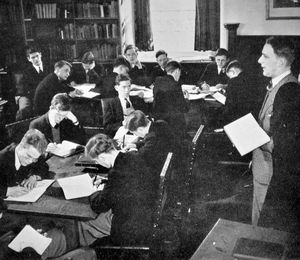
Palin, who was at Shrewsbury a little later than the Private Eye founders, would later recall: “We had this great teacher called Laurence Le Quesne who was very encouraging and taught us to think for ourselves. We used to have a lesson in the library and a lot of the time he’d tell us just to read because he just liked to be in the library with his books (n.b. on being told that Mr Le Quesne said it was a “slight exaggeration”). We’d sit there and he’d dance around the shelves, picking out books and going ‘ni… ni’. He eventually became the inspiration for The Knights Who Say Ni in Monty Python and the Holy Grail.”
Mr Le Quesne’s surname - pronounced Le Cane - came from his Jersey roots, and means oak tree in Jersey French. As a boy he was on the last civilian evacuation flight before the Germans seized the island in 1940.
He was head of history at Shrewsbury School for seven years. He had gone there straight from Oxford University in 1951, the start of a long association broken by periods lecturing in history at Tasmania University, where he met English-born future wife Mary Parks who was doing a degree in history, and lecturing at Sydney University from 1964 to 1968. One story has it that when they became engaged she was warned her future husband was “the man responsible for the 1960s.” They married in 1964.
On the family’s return he bought the house of famous Victorian diarist Francis Kilvert at Clyro on the Welsh border. Like Kilvert, Mr Le Quesne assiduously wrote a daily diary and his idea of comparing their diary entries exactly 100 years apart resulted in his first published book, called After Kilvert. Mr Le Quesne’s diary is now at Shrewsbury School’s Moser Library.
Moving to Shrewsbury in 1972, he retired from teaching at Shrewsbury School full time in 1989, and did another five years part time. He continued to be involved with the school, taught classes at The Gateway, and led tours for the National Trust.
Cricket was a great passion, and Charles said: “It was very characteristic of my dad that when he was captain of the school second XI he was an underarm spin bowler, the ball moving at right angles in a most alarming way.”
He said his father had a fantastic sense of the ridiculous, sometimes wearing silly hats, and during one school debate on the meaning of boredom took along a gong which he bonged repeatedly for his five-minute contribution. “He just stood there and hit the gong, and said ‘repetition is the essence of boredom.’”
Despite his role in unlocking the boom in British satire, he was not interested in it. One of the Private Eye founders sent him a prototype of the new magazine to see what he thought, and he lost it. And when they gave him a lifetime subscription, he cancelled it.
A widower, Mr Le Quesne is survived by children Charles, Elizabeth and John, and four grandchildren. There will be a service of thanksgiving at St Chad’s Church, Shrewsbury, at noon on Saturday March 21.