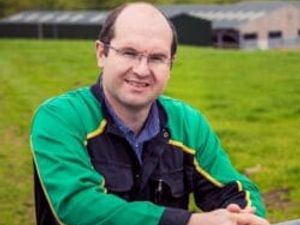
Dairy giants putting investment at risk, says NFU chief on Shropshire visit
Dairy giants like Muller risk undermining the huge investments they have made in Shropshire if they do not pay a higher price for their milk, the head of Britain's farming union has warned.
Muller has spent millions of pounds on extending its facilities in the county, including buying the former Nom factory in Telford and building a butter factory beside its base in Market Drayton.
But on a visit to Telford yesterday, NFU president Meurig Raymond said dairy processors will not benefit from those investments if they do not pay a higher price for milk.
Last week, Muller announced it will cut 1.75p per litre from the price it pays for milk on March 5, taking its standard rate to 24.15p.
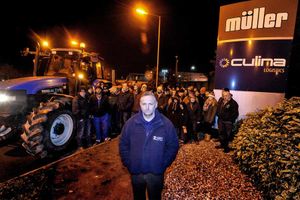
Dozens of farmers blockaded the Shropshire headquarters of dairy processing giant Muller Wiseman to protest against falling milk prices.
They made it difficult for vehicles to enter or leave the Market Drayton-based dairy as drivers were forced to turn away.
Farmers from across Shropshire and neighbouring counties were among the more than 50-strong group which braved the cold weather at the protest last night.
It was the latest in a series of protests Farmers For Action has organised around the country over the last few months after dairy processors, including Muller Wiseman, slashed the price they pay farmers for milk. This month the German firm announced it will cut 1.75 pence per litre from the price it pays for milk on March 5, taking its standard rate to 24.15ppl.
About 12 months ago farmers were receiving about 32 to 33ppl.
Speaking at last night's protest, Paul Rowbottom, a member of FFA, said: "There could always be more but I am pleased with the turnout.
"I think there are farmers who are concerned about coming out to protest because of fears they might lose their contracts.
"Milk prices need to go back up because there are farmers out there who fear losing their businesses. If they go back up then we won't protest."
Carl Ravenhall, managing director of Muller Wiseman Dairies, said the firm continues to take "very difficult and painful decisions" to ensure that its costs are as low as they can be.
"The investment we have seen from Muller and Arla sends a positive message," said Mr Raymond, who farms 600 dairy cows in Wales and was speaking at the Energy Now Expo at Telford's International Centre.
"They have invested in the UK and see their future here, but to build on that investment they need a supply of milk and the levels they are paying will jeopardise their long-term security of milk.
"When you read their last statement they seemed to indicate they were reducing the price as they felt they were out of line with their competitors. That's no reason to reduce prices, and they won't guarantee security of supply if these prices drive dairy farmers out of production."
Mr Raymond warned the low price is threatening to force many farmers out of business, particularly among the 25 per cent of those in the industry who are paid 20p or less for their milk.
Muller's suppliers are in a middle bracket of around half of producers who are struggling to make ends meet, whereas those who supply the biggest supermarket chains enjoy prices of 31p to 33p per litre.
It costs a farmer 30p on average to produce a litre of milk.
However, he added that there are positive sights on the horizon which suggest that the milk price could begin to rebalance.
"Now is the time to get behind British dairy farming," he said.
"You analyse the global market and we have seen small increases in the last four weeks in the value of skimmed milk powder, butter and cheese globally. That to me says demand is picking up and prices are starting to lift out of the trough, so you have to question why we are still seeing price reductions in the UK.
"The biggest milk cooperative in Holland has put prices up for next month.
"At a time when hopefully the value of dairy product is coming out of the trough we are still seeing reductions in the UK and that sends totally the wrong message to milk producers who are really struggling with cash flow."
He added: "Some farmers are going to exit the industry in the next couple of months, they've already made the decision. It's that 25 per cent of the industry receiving 20p per litre or less. The question for them is how long are they prepared to keep losing money, at what point does their bank decide they won't lend them any more money?"
He added: "You can bet at least five businesses are living off those farms, from vets to nutritionist to financial advisers to staff that are employed. No sector of British farming has a greater multiplying effect into the local community than dairy farming, and you are putting all those businesses into jeopardy."
The day before his visit to Shropshire, Mr Raymond was part of a round-table meeting which included farming minister Liz Truss. Measures are now being considered to help farmers, including changes to the system of tax payments.
A spokesman for Müller UK & Ireland Group: said: "If we are to continue to find markets for the fresh milk products that we make, we must be able to compete against companies, including those owned by farmers, who are paying lower milk prices.
"The market for farm-gate milk throughout the UK and around the world is depressed, but we will continue to meet our commitment to invest in adding value to milk from British farms, and pay a leading price to the farmers who choose to supply us."