Shrewsbury festival will celebrate key anniversary in the history of Christianity
A festival of art, music, talks and pilgrimage is to be held in Shrewsbury to mark 1,700 years since one of the most important events in the history of the Christian Church.
The ‘Nicaea 2025’ festival will celebrate the anniversary of the first Council of Nicaea, held in 325AD, which formulated the Nicene Creed, the core declaration of faith that lies at the heart of Christian belief.
All the main branches of Christianity share the Nicene Creed, which affirms belief in the Trinitarian God.
Catholic, Anglican, Orthodox and major Protestant denominations, throughout the world, are marking the anniversary under the unifying banner of ‘Nicaea 2025’.
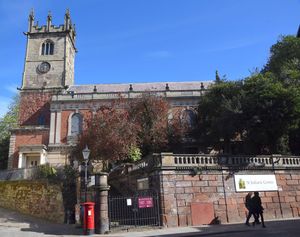
Public events for the Nicaea 2025 festival in Shrewsbury include a two-week art exhibition of holy icons, from May 24 to June 6 at St Julian’s Church, featuring works by leading Western contemporary icon painters, an international concert of ancient sacred music on May 25 at Shrewsbury Cathedral, and a series of talks by international speakers.
The festival, organised by the Shrewsbury Orthodox Church, will also form the centre of celebration for Orthodox Christians in Britain with visitors expected to travel from across the UK.
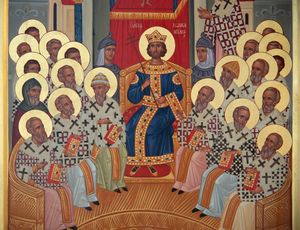
The Greek Orthodox Archdiocese of Thyateira and Great Britain chose Shrewsbury to host its national celebrations because the town’s Orthodox Church is thought to be the only church in Western Europe dedicated to the ‘318 Holy Fathers of Nicaea’.
Other events include an open day at the historic 13th century church at Sutton, Shrewsbury, on May 31, and a symposium on June 21, featuring theologian Reverend Professor John Behr, a leading scholar on the formation of Christian theology.
The Council of Nicaea was a historic gathering of 318 bishops, from across the Roman Empire, in the ancient city of Nicaea, now in modern Turkey.
Held shortly after the legalisation of Christianity, it played a critical role in shaping the theological foundations and unity of Christianity.
It was called by the first Christian Roman Emperor Constantine for bishops to settle major divisions that had arisen within the Church, particularly Arianism, the controversial teaching of the charismatic preacher Arius who challenged the fundamental Christian belief that Jesus Christ was the incarnation of God. Arius claimed Christ was created and not fully divine.
The controversy threatened stability within the empire and was a major topic of public debate among ordinary people, even leading to street fights.
The council’s debates centred on the teaching of the Apostles and resulted in the rejection of Arianism and the formulation of the Creed to affirm Christian belief in the Trinitarian God and the divinity of Christ. The Nicene Creed is still recited during Eucharistic services today.
Shrewsbury Orthodox priest Father Panteleimon Maxfield said: “We are delighted to host this public festival of celebration to which all visitors are welcome.
“The Council of Nicaea was a defining moment for the Christian Church and the first major event after the legalisation of Christianity. Many of those present had suffered torture under Roman persecution and were disfigured in an appalling way, with eyes and limbs missing. They were ‘confessors’, living witnesses of the faith.
“The Council refuted the heresy of Arianism and established the Creed to affirm the teaching of the Apostles, that Christ was fully God and fully man. The icon exhibition is a key part of our celebrations because iconography, in itself, is a celebration of the incarnation of God which is central to the Christian faith and the Council’s deliberations.”
For details of the Nicaea 2025 festival visit https://shrewsburyorthodox.com/nicaea25/