Telford company behind weird and wonderful vision of the future
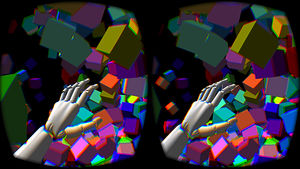
Dangling in the air, rich in colour against the blackness all around, are hundreds of small cubes, writes Business Editor Thom Kennedy.
Utterly motionless, with no wind or gravity pulling at them, they sit weightlessly, interrupted only when a robotic arm swings through the pitch black and swipes childishly at the rudimentary shapes.
Looking down, it appears that these limbs, fibreglass perhaps, with their fingers and palms connected by white hinges, appear to be extensions of my the user's own form.
This is how life appears when you are dropped into The Rift.
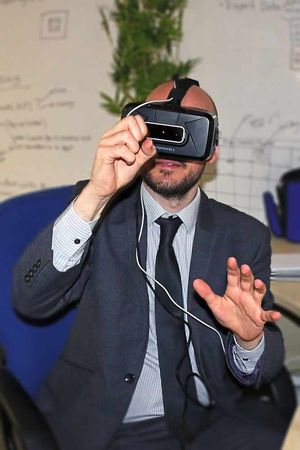
My gaming days are, for the most part, well behind me, writes Business Editor Thom Kennedy.
The most cutting edge software I own is a festering PlayStation 2 that I keep in the cellar, my memories of the button combinations on Streetfighter 2 are long-since faded, and Steve McLaren has led a team to a major cup since I last landed any silverware on Championship Manager. So to pull on the Oculus Rift headset was to exit technological isolation after years spent in the dark.
I was immersed in a new version of reality, of floating shapes and super-realistic jet fighter cockpits. You can also accidentally eject yourself from the cockpit . Each time I glide gently into the cockpit of apassing F10, a coincidence that might even have slipped through the grasp of Arthur Dent in The Hitchhiker's Guide To The Galaxy.
My virtual world wasn't controlled by my knowledge of where to find X, square, triangle and circle without having the occasional glance down, but by my own ability to roam in a pixellated realm.
I have no doubt that word of mouth alone will make Oculus Rift one of the most in-demand pieces of tech on the market in 2015 – if indeed it is released next year.
More precisely, this is Oculus Rift, the future of gaming, in which users wear a full headset to completely immerse them in a virtual world.
The headset, which has to be pulled taut over the bonce, belongs to Telford-based software developers Bronze Labs.
The cutting-edge business, which is simultaneously developing programs for Google Glass, has combined the set with movement sensors from Leap Motion so when you look through the screens inside the set, you can interact with the world that you see without using a handset.
Instead, by waving a hand at objects in your eyeline, you can move things that you can find in "The Rift" – in this program's case, those hundreds of colourful floating cubes.
But the Priorslee company isn't joining the ranks of developers using this technology for gaming, and is instead looking at its real world applications such as training.
To that end, when you are plonked into the cockpit of an F10 fighter jet, you will by looking around be able to fire rockets, see the real workings of a plane in flight above a hyper-realistic ocean.
Company director Rich Howells said: "We have taken one of the most advanced virtual reality technologies out there and one of the most advanced hand and motion detection technologies and combined them into one environment.
"We take on all this new technology and explore it, and in doing so we have come up with an extremely powerful way to cut the costs of training for businesses.
"That has major implications for training on aircraft and vehicles.
"We have spoken to people who have sat in front of computers and looked at vehicles they are supposed to be servicing or changing parts on, and when they get to the actual vehicle they have struggled to apply their teaching.
"With Oculus Rift, they can do all that training in The Rift. What you currently get on multi-million pound simulators, we can achieve with our technology."
The maker of the new headset was bought out by Facebook in a deal worth about £1.3 billion earlier this year, although its release date for the general market is not expected to come for much longer.
Developers around the world are racing to prepare games to use on the new device, and bosses at Bronze hope their alternative approach will also bear fruit in the months to come.
"It's a case of taking cutting-edge technology and applying it to a corporate environment," Mr Howells added.
"We are in a research and development relationship with some major organisations, that pay a fortune to run simulators.
"They are having to show ways they are cutting back costs, and here is a like-for-like piece of technology that instead of costing millions, it costs a few thousand to achieve the same level of training.
"The one thing we want to add is a chair that gives you some feedback – for example a Formula 1 seat that can give you the feel of being in a F1 car, and we are talking with an F1 team which was blown away by it."
Design lead Jamie Gough said: "Architecture is another classic case. They can assess whether different designs would work by using this simulator.
"A lot of our technology is quite fun, and that's closely linked to our culture here. We love what we do, and that really comes through in what we work on for clients."