Health bosses blackout vow
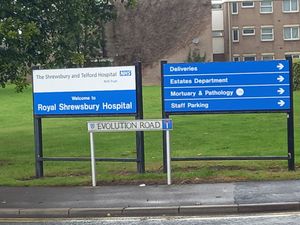
Health bosses have vowed to learn lessons after an emergency power supply failed to kick in when a Shropshire hospital was in the grip of a power cut caused by a bird. Health bosses have vowed to learn lessons after an emergency power supply failed to kick in when a Shropshire hospital was in the grip of a power cut caused by a bird. The Royal Shrewsbury Hospital was struck by the power cut, which also affected more than 50,000 properties in central Shropshire, just after 7pm on Friday. It was caused by a bird flying into electricity cables. Extra staff had to be drafted in as the RSH was thrown into turmoil because of the incident. Patients receiving critical care had to be checked over by emergency staff. Read the full story in today's Shropshire Star.
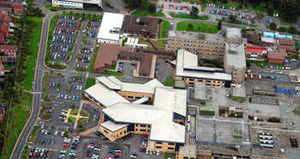
The Royal Shrewsbury Hospital was struck by the power cut, which also affected more than 50,000 properties in central Shropshire, just after 7pm on Friday.
It was caused by a bird flying into electricity cables.
Extra staff had to be drafted in as the RSH was thrown into turmoil because of the incident.
Patients receiving critical care had to be checked over by emergency staff.
Claire Tellis-Doherty, of Berwick Wharf, Shrewsbury, whose father Ivan Tellis, 71, was in the hospital's intensive care unit during the blackout, today said: "It is absolutely unacceptable that a bird flying into a power line can bring the Royal Shrewsbury Hospital to a complete standstill, thereby putting numerous lives at high risk.
Sickened
"My father is very ill. I feel sickened to think that he could have died on Friday night due to a failure by the treating hospital during a power cut."
Bosses say the power cut lasted about 20 minutes but had a "major impact" on the hospital as its back-up power systems failed.
Tom Taylor, chief executive of The Shrewsbury and Telford Hospital NHS Trust, said: "We'd like to reassure everyone that the power was back on at the hospital soon afterwards and all systems appear to be back to normal."
Some patients had their dialysis sessions cut short when the power supply failed, he added.
Many of those affected will have their sessions rescheduled.
Mr Taylor said: "Now that everything is getting back to normal our next focus will be to understand why our back-up power systems didn't immediately kick in and to prevent this happening in future.
"Obviously our priority is to our patients, so our immediate focus was the people in critical care and on other systems needing electricity," he added.
"Importantly, critical support systems have battery power which allows them to work even when mains electricity is lost."
He apologised to patients and their families for any inconvenience caused.
By Tom Johannsen and Russell Roberts