WWI's Tunnels of Death: The Big Dig - TV review
It's a funny old thing, fate. Take George Babbage, an ordinary British soldier serving near the Belgian village of Messines.
One day he went to help a comrade who had been hit by a sniper, only to be met by a bullet himself.
Meanwhile, on the other side of No Man's Land, a young Adolf Hitler was spending his off-duty hours painting the ruined church of Messines while somehow managing to survive every bullet and shell the British could fling in his direction.
Adolf got to return home to arrange the rematch, while George left behind a wife and children, including a little boy he had never even seen, and became one of the thousands of names on war memorials throughout the land.
His story also helped Channel Five's entry for Bafta's coveted 'Most Clumsy Title Award 2012' put a human face on casualty figures that are otherwise too enormous to take in.
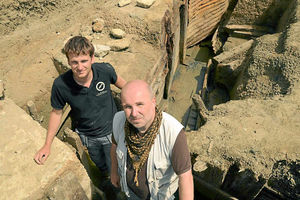
'Tunnels of Death' followed an eight month archaeological dig to explore the former battlefields at Messines before the local water company arrives to put a mains pipe over them. Apparently you can do that in Belgium.
Mind you, for a programme billed as being about 'tunnels of death', I didn't see a lot of tunnels.
Death, on the other hand, you could sense standing just out of frame throughout.
Thousands of men were killed in those battlefields during four years of conflict, and almost a century later each excavation site still has to be swept for left-over explosives and gas shells before work can begin.
Even the mechanical diggers are armour-plated.
As they dug down just below the surface we saw the archaeologists picking up bullet casings here, a roll of barbed wire there, and the jawbone of a horse that was probably used to transport supplies to the front line.
There was a soldier's fountain pen buried in the clay. "The cap still screws on," cooed one of the archaeologists, amazed that, somehow, all of this history got covered over and left behind.
Then they came across a small part of the German trench line that once stretched 450 miles to the Swiss border.
Its floorboards were still in place, as were the bits of wood the troops used to reinforce its battle-damaged walls.
One section even contained the tip of the shell that slammed into it and the damaged wood dislodged by the blast: an explosion preserved in mud for 100 years.
At that moment I wanted nothing more than to pick up a trowel and head over to Belgium. Now that's an interesting job.
For despite its title, this was a first-rate documentary presented with taste and intelligence and a clear intention to explain history.
We learned how trench warfare came about, how the lines were constructed, how soldiers lived their lives and the dangers they faced, such as the gas attacks that left victims 'drowning on dry land'.
And yet, call me ghoulish, I still wanted to see the 'tunnels of death' they promised me.
So the producers – who can clearly read me like a book – showed just a glimpse of one at the end of the programme to make sure I tune in next week.
And I'll be there. I recommend you look in as well.
Andrew Owen