Dara O Briain's Science Club - TV review
Coming up with a fresh idea for a TV programme is difficult. Coming up with something for the small screen which is intelligent and yet eminently watchable is very difficult.
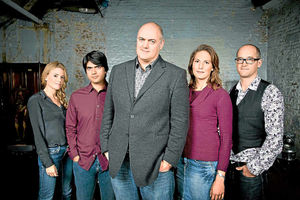
Coming up with something which is not only fresh but also intelligent and truly watchable is akin to trying to nail jelly to the ceiling – but Dara O Briain seems to have managed it.
His new series, which made its debut last night, looks like being an effective antidote to the seemingly endless stream of vacuous Factor My Dance Brother's X drivel which piles up on the schedules like bat guano in a cave.
The title Science Club may conjure up images of bespectacled, tank top-clad Herberts in a classroom trying to make thermo-nuclear particle accelerators out of corn flakes boxes after school when all their classmates have long since run from the sound of the bell and gone to play football or climb trees. It doesn't really inspire – but the content does.
In the world of science on TV, the show takes over from where Tomorrow's World left off nine years ago when it was taken off the airwaves. Throw in a hint of Stephen Fry's QI, a dash of Horizon, even a taste of those Royal Society Christmas Lectures and you are getting close to what was on offer in what was the first of a six-part series.
Stuffiness is always a danger with anything remotely cerebral on The Box but an almost zoo-like format, with a standing audience of young things and not a tank top in sight, helped to stop any dust settling.
Three other ingredients were key. Humour, and the hour-long show was liberally sprinkled with it, a celebrity here or there – last night it was comic Ed Byrne, – guest experts, reporters and, of course, O Briain himself.
The man is, in the best possible way, a bit of an oddity. He is a funny, funny guy with an instantly warm and engaging personality but while others in his trade were either making people laugh at the JobCentre or studying art, English or politics in their early 20s he attended University College, Dublin, where he took a degree in the deeply unfunny subjects mathematics and theoretical physics, both more involved with splitting atoms than splitting sides.
He was auditor of the university's oldest debating society and won both the Irish Times National Debating Championship in 1994 and the Irish Times/Gael Linn Irish language debating contest.
An all round smarty pants with a talent for tickling the chuckle muscle was surely the only choice to front-up this show.
Each week the team will take a single subject and examine it from lots of different and unexpected angles – from extinction to sex, Einstein to space exploration and brain chemistry to music – all underpinned by first-class science.
O Briain, in the promotional blurb for the series, says: "It's for anyone who, like me, is curious about space, brains, extinction and sex and all the great ideas about how the universe works.
"And if that doesn't grab you, we'll show you how to measure the speed of light using cheese on toast or find your DNA with strong Polish vodka."
The field of investigation last night was reproduction and inheritance (genetic, not fiscal) and the topic was not only fascinating but also up-to-the-minute and very informative.
Did you know your genetic make-up can be altered by environmental factors such as your diet and health? No? Well, you would if you'd watched Science Club.
Would having sex on an exercise bike ensure healthy and fit babies who might otherwise be debilitated in some way? The question was posed.
Thankfully, we were told, science has yet to test the theory.
Science Club looks like being an entertaining and highly educational island in a sea of dross and I, for one, will be tuning in for the rest of the series.
Next week's subject is the daddy of them all, scientifically speaking – Albert Einstein. He was surely crying out for something like Science Club when he famously said: "Two things are infinite – the universe and human stupidity, and I'm not sure about the universe."
Simon Hardy