Fears grow of regional instability after death of Iran’s leader
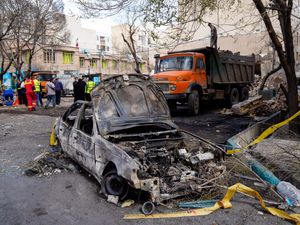
Ayatollah Ali Khamenei was killed in a major attack on Iran launched by Israel and the United States on Saturday.
Iranian Supreme Leader Ayatollah Ali Khamenei was killed in a major attack on Iran launched by Israel and the United States, throwing the future of the Islamic Republic into doubt.
The killing of Mr Khamenei after decades in power has sparked angry scenes in other parts of the Middle East and elsewhere, raising the risk of potential regional instability.
In Pakistan, at least nine people were killed in violent clashes with police and paramilitary forces after hundreds of protesters stormed the US Consulate in the port city of Karachi.
Police and officials at a hospital in Karachi said at least 25 people were also wounded in the clashes and some of them are in a critical condition. Police said the protesters were later dispersed and the situation was under control.

The US Embassy in Pakistan wrote on X that it is monitoring reports of ongoing demonstrations at the US Consulates General in Karachi and Lahore, as well as calls for additional protests at the American Embassy in Islamabad and the Consulate General in Peshawar.
It advised US citizens in Pakistan to monitor local news, stay aware of their surroundings, avoid large crowds and keep their travel registration with the US government up to date.
Pakistan Prime Minister Shehbaz Sharif, meanwhile, conveyed his condolences to Tehran following the killing of Mr Khamenei. He said his country is gravely concerned about the violation of international law, as heads of state should not be targeted.
Abdel-Fattah el-Sissi, the president of Egypt, has warned the Middle East could slide into chaos amid the conflict.
He called for “dialogue and peaceful means” to settle the region’s crises, saying the escalation could have serious consequences
Mr El-Sissi’s comments came in a phone call on Sunday with Oman’s leader, Sultan Haitham bin Tariq Al Said, according to the Egyptian leader’s office.
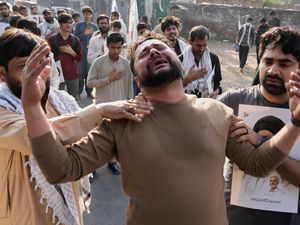
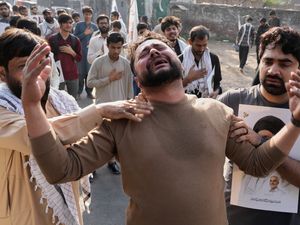
Tens of thousands of people in Indian-controlled Kashmir have staged a massive demonstrations to denounce the killing.
Since early on Sunday, mostly Shiite Muslims hit the streets across the region as they chanted “Death to America” and “Death to Israel”.
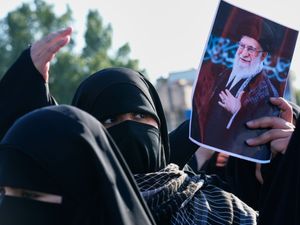
Some wailed in mourning while carrying Mr Khamenei’s portrait.
The Iranian leader enjoyed a significant following in Kashmir among Shiite Muslims, and his portrait adorned several streets prominently across the region.
Mirwaiz Umar Farooq, a prominent Kashmiri religious leader, voiced deep sorrow and outrage over what he termed the “brutal killing” of the Iranian leader. He said in a statement the killing “has shaken the Muslim world” and called for a protest strike in Kashmir on Monday.
Officials in Oman said an oil tanker in the strategic Strait of Hormuz has come under attack, injuring four mariners on board.

The attack targeted a Palau-flagged vessel called Skylight, the state-run Oman News Agency said. It described the crew as Indian and Iranian.
It was not clear who attacked the vessel, but it came as authorities have said Iran has been threatening ships travelling the strait via radio since the United States and Israel launched its attack on Iran.
Also in Oman, Iran struck the port of Duqm, which has been used by the US Navy as a logistical hub and is capable of hosting aircraft carriers.
In Iraq, a militant group claimed responsibility for a drone attack “targeting American bases in Irbil”, according to the Rudaw media outlet.
Smoke could be seen from an area where the US has an air base there, but it was not immediately clear whether it had been hit.
Elsewhere, a protest took place in Baghdad against the military operation in Iran.

China’s foreign minister Wang Yi sharply criticised the killing of Mr Khamenei in a phone call with his Russian counterpart Sergei Lavrov.
“The blatant killing of the leader of a sovereign state and the incitement of regime change are unacceptable,” he was quoted as saying by China’s official Xinhua News Agency. “These actions violate international law and the basic norms governing international relations.”
He said attacking a sovereign state without UN Security Council authorisation undermines the foundation for peace established after the Second World War.
“The international community should speak in a clear and unequivocal voice, opposing the world regressing to the law of the jungle,” he added.
Hundreds of protesters gathered at multiple locations in Istanbul in Turkey to denounce the Israeli-US attacks on Iran.
A demonstration in front of Israel’s consulate ended with protesters burning the US and Israeli flags as well as posters of US President Donald Trump and Israeli Prime Minister Benjamin Netanyahu.

A protest was also held near city hall, where people chanted and held up signs against Israel and the US.
“We reject and denounce American oppression and America’s actions,” one of the protesters, Ahmet Agirakca, told The Associated Press.
“We have gathered here not only to condemn but also to show that we will fight against them for the rest of our lives.”
Another protester, Ali Emre, said he was there to show solidarity with Muslims “and to protest Trump, the USA, and global imperialism”.
Meanwhile, Iranians in Germany took to the streets to celebrate the death of Mr Khamenei.
Hundreds gathered in front of the US embassy in Berlin. They held pre-1979 Iranian flags as well as Israeli and American flags, as they danced and sang near the Brandenburg Gate.

Demonstrators included supporters of Reza Pahlavi, the exiled son of Iran’s last shah overthrown during the 1979 Islamic Revolution.
More than 1,000 people also celebrated in the Austrian capital Vienna, according to the city police quoted by the Austrian press agency.
Elsewhere, hundreds of supporters of the Iranian-backed Hezbollah militant group gathered south of Beirut, in Lebanon, to mourn the death of Mr Khamenei.
They chanted anthems and slogans paying tribute to Mr Khamenei and Iran. They waved the flags of Iran and Hezbollah, some beating their chests.
Hezbollah is Iran’s most powerful proxy in the region, but it suffered heavy losses in a months-long war with Israel in 2024.
It has not taken military action in solidarity with Tehran, as Lebanon’s political leadership tries to keep the nation out of the conflict for fears of a spillover.