Iran’s Revolutionary Guard leader warns US: ‘Finger is on the trigger’
US warships are currently heading towards the Middle East.
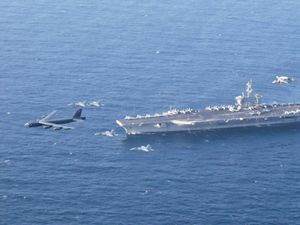
Iran’s paramilitary Revolutionary Guard is “more ready than ever, finger on the trigger”, its commander has said, as US warships head towards the Middle East.
Gen Mohammad Pakpour warned the United States and Israel “to avoid any miscalculation”, in comments reported on Telegram by Nournews, a news outlet close to Iran’s Supreme National Security Council.
The Revolutionary Guard has been key in putting down recent Iran-wide anti-government protests that have left thousands of people dead.
Gen Pakpour was quoted as saying: “The Islamic Revolutionary Guards and dear Iran stand more ready than ever, finger on the trigger, to execute the orders and directives of the Commander-in-Chief.”
Meanwhile, the number of people reported by activists as having been arrested jumped to more than 40,000, as fears grow some could face the death penalty.
Tension remains high between Iran and the US in the wake of a bloody crackdown on protests that began on December 28, triggered by the collapse of Iran’s currency, the rial. Protests swept the country for about two weeks.
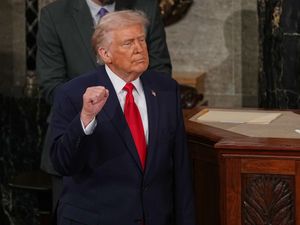
US President Donald Trump has repeatedly warned Tehran, setting two red lines for the use of military force: the killing of peaceful demonstrators and the mass execution of people arrested in the protests.
Mr Trump has said Iran halted the execution of 800 people detained in the protests. He has not elaborated on the source of the claim – which Iran’s top prosecutor, Mohammad Movahedi, strongly denied on Friday in comments carried by the judiciary’s Mizan news agency.

On Thursday, Mr Trump said aboard Air Force One that the US is moving warships toward Iran “just in case” he wants to take action.
“We have a massive fleet heading in that direction and maybe we won’t have to use it,” Mr Trump said.
A US Navy official said on Thursday that the aircraft carrier USS Abraham Lincoln and other warships travelling with it are in the Indian Ocean.
Mr Trump also mentioned the multiple rounds of talks American officials had with Iran over its nuclear programme before Israel launched a 12-day war against the Islamic Republic in June, which also saw US warplanes bomb Iranian nuclear sites.
He threatened Iran with military action that would make earlier American strikes against Iranian uranium enrichment sites “look like peanuts”.
“They should have made a deal before we hit them,” Mr Trump said.
The tension has led at least two European airlines to suspend some flights to the wider region.
Air France cancelled two return flights from Paris to Dubai over the weekend.
The airline said it was “closely following developments in the Middle East in real time and continuously monitors the geopolitical situation in the territories served and overflown by its aircraft in order to ensure the highest level of flight safety and security”.
It said it would resume its service to Dubai later on Saturday.
Luxair said it had postponed its Saturday flight from Luxembourg to Dubai by 24 hours “in light of ongoing tensions and insecurity affecting the region’s airspace, and in line with measures taken by several other airlines”.
It told the AP it was closely monitoring the situation “and a decision on whether the flight will operate tomorrow will be taken based on the ongoing assessment”.
Arrivals information at Dubai’s international airport also showed the cancellation of Saturday flights from Amsterdam by Dutch carriers KLM and Transavia.
Some KLM flights to Tel Aviv in Israel were also cancelled on Friday and Saturday, according to online flight trackers.

Although there have been no further demonstrations in Iran for days, the death toll reported by activists has continued to rise as information trickles out despite the most comprehensive internet blackout in Iran’s history, which has now lasted more than two weeks.
On Saturday, the US-based Human Rights Activists News Agency put the death toll at 5,137, with the number expected to increase.
The activist agency on Saturday also increased the total number of people arrested to 40,879 — a significant jump from the more than 27,700 people in its previous update.
The group’s figures have been accurate in previous unrest and rely on a network of activists in Iran to verify deaths.
That death toll exceeds that of any other round of protest or unrest there in decades, and recalls the chaos surrounding Iran’s 1979 Islamic Revolution.
Iran’s government offered its first death toll on Wednesday, saying 3,117 people were killed. It said 2,427 were civilians and security forces, and labelled the rest as “terrorists”.
In the past, Iran’s theocracy has undercounted or not reported fatalities from unrest.
There have been fears Iran could apply the death penalty to arrested protesters, as it has done in the past.
Iranian judiciary officials have called some of those being held “mohareb” — or “enemies of God” — a charge that carries the death penalty. It had been used along with other charges to carry out mass executions in 1988 that reportedly killed at least 5,000 people.
At a UN Human Rights Council special session on Iran held in Geneva on Friday, Volker Turk, the UN’s high commissioner for human rights, expressed concern over “contradictory statements from the Iranian authorities about whether those detained in connection with the protests may be executed”.
He said Iran “remains among the top executioner states in the world,” with at least 1,500 people reportedly executed last year — a 50% increase over 2024.