Meningitis outbreak: Students turned away for vaccines in Kent
Two students have died and others are being treated in hospital as health officials try to establish why meningitis has spread so rapidly.
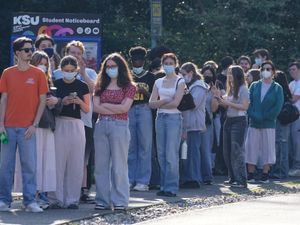
More than 100 students in Kent have been turned away while trying to get a meningitis vaccine after officials closed the queue.
The University of Kent said it had closed the vaccine queue on its Canterbury campus “due to capacity” because it needed to finish the clinic by 5pm.
More than 100 people who had been waiting for a jab were turned away, according to Press Association estimates of the queue size.
In a Facebook post on the day confirmed or suspected meningitis cases rose to 27, the university said: “The queue has been closed as nursing staff are unable to see any more people within the clinic’s remaining opening hours today.
“The team have been working incredibly hard to vaccinate as many people as possible.”
The university said the vaccination clinic will reopen on Friday from 9am to 5pm, and advised people to be in the queue by 2pm.
At 4.10pm on Thursday, students were still trying to join the queue but security staff turned them away.
Dozens who had already been waiting in line were also told to go home.

Those trying to join were told that medical staff administering vaccines had to work out how many people they could fit in before the service officially closed at 5pm.
It is understood staff wanted to vaccinate the final person at 4.30pm, in order to give them enough time to sit during the necessary 15-minute observation period to ensure they had no immediate side-effects.
Earlier on Thursday, Health Secretary Wes Streeting said more people affected by the meningitis outbreak will be vaccinated.
Mr Streeting said anyone who attended local venue Club Chemistry from March 5 until March 15 would be offered the jab, alongside sixth-formers at four schools and other university students in Canterbury.
On Friday, more vaccination centres are due to open across Kent as the Government’s immunisation programme expands.
One facility, located at Faversham Health Centre, will begin administering jabs at 9am on Friday and will remain open through Saturday, while additional clinics are scheduled to open on Friday at the Vicarage Lane Clinic in Ashford and at the University of Kent, NHS England has said.
The UK Health Security Agency (UKHSA) said that as of 5pm on Wednesday, 15 cases of meningitis have been confirmed and a further 12 are under investigation.
This takes the total to 27 cases of either confirmed or suspected meningitis, up from 20 on Wednesday. Two students have died in the outbreak.
On a visit to the University of Kent, Mr Streeting said: “We are now encouraging anyone who attended Club Chemistry from March 5 until it voluntarily closed to come forward for both antibiotics and vaccination.
“Furthermore, we’re expanding vaccination to anyone who’s previously been offered the prophylactic antibiotic.
“That will include a large number of students here at the University of Kent.
“And it will include some students at Canterbury Christchurch University.
“It will also include sixth-formers at four schools where there are known or suspected cases.
“These are proportionate steps to help us contain spread and we’re keeping that situation under review.”

The UKHSA said all patients eligible for antibiotics will now be able to request a vaccination and antibiotics “from their local GP immediately – wherever they are in England”. This covers students who have travelled home.
More than 8,500 antibiotics and 1,600 vaccines have been now given to eligible people in Kent amid the meningitis outbreak.
A student who went to Club Chemistry on March 12 was turned away from the vaccine queue on Thursday.
Hayden Taylor, 19, a radiography student at Canterbury Christ Church, arrived at the campus vaccine clinic at around 3pm on Thursday.
He told PA: “I had the antibiotics already. We already knew it was going to be busy.”
Isobel, 21, an English literature student at the University of Kent, was turned away after her mother drove them 80 minutes to the centre.
Speaking to PA, Isobel, who chose not to give her last name, said: “My mum has had to drive me an hour and 20 minutes to get the vaccine.
“It is very inconvenient. I’m coming back tomorrow and hope that they have got some.”
In other developments:
– Mr Streeting told BBC Newsbeat young people should be cautious about sharing vapes, but added he is not the “fun police”. He said that as a “rule of thumb” it is “not hygienic to share things like vapes around your mates”. Mr Streeting added: “It’s absolutely fine for people to go about living their lives in a normal way and there is no reason for me to be the fun police today and tell students across the country that they shouldn’t be going out this weekend and doing the things that they would normally do in a nightclub.”
– Morrisons confirmed an employee at its Sittingbourne distribution centre who attended Club Chemistry has contracted meningitis.
– Olivia Parkins, 18, who is part of the cheerleading society at the University of Kent, told PA there have been three confirmed cases within the group – all of whom are in hospital.
– The UKHSA said four schools in Kent have confirmed cases of meningitis, while the London animation and games school Escape Studios said one if its students with links to the county had contracted meningitis.
– The agency said the NHS Kent and Medway website will be updated shortly with vaccination sites for all those eligible for a menB jab.
– UKHSA also said 20,000 vaccines from the NHS supply will be made available to the private market to ease the demand at pharmacies from people who want to pay for a jab.
– Louise Jones-Roberts, who owns Club Chemistry, told PA: “I’m really pleased, I’m over the moon there are more vaccines. I’d like to see it given to all under-25s though. It needs to be looked at right across the country. As for reopening the club, there will come a time when it feels OK to open and we will know when the time is right, but it’s definitely not going to be this weekend.”
– Kent County Council’s director of public health, Dr Anjan Ghosh, told BBC Radio 4’s Today programme they were not in the position yet to say that definitively the outbreak has been contained.”
Professor Robin May, UKHSA chief scientific officer, said on Thursday “this is a very unusual outbreak”, adding experts were looking at why meningitis in these cases may have become more transmissible between people.
Speaking to BBC Breakfast, Prof May said: “Typically, you would expect to see sporadic cases of meningitis, typically individual patients. Most days, actually, we would see one in the UK.
“What is particularly remarkable about this case, and unexpected about this case, is the large number of cases all originating from what seems to be a single event.
“There are two possible reasons for that. One is that there might be something about the kind of behaviours that individual people are doing.
“The other possibility is the bacteria itself may have evolved to be better at transmitting.”
Prof May said the bacteria which can cause meningitis can be transmitted by sharing utensils, cups and vapes.