RSPB hails boost for bird species but says ‘still a lot of work to be done’
The capercaillie was once more widely spread across the UK but is now confined to native pinewood forests of Scotland.
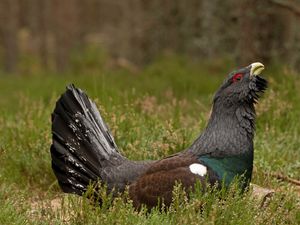
The RSPB has revealed a significant boost for the critically threatened capercaillie in Scotland.
RSPB Abernethy recorded 30 lekking males in 2025, a 50% increase since 2020.
The capercaillie was once more widely spread across the UK but is now confined to native pinewood forests of Scotland where the total population is estimated at 532 birds.
The Scottish Government has announced the Capercaillie Emergency Plan, led by the Cairngorms National Park Authority and NatureScot, with the aim of reversing long-term population declines in the species.
Two innovative trial methods involving a remote-controlled mower and “virtual fence” cattle collars for large-scale management of their vital pinewood habitat are part of the huge conservation efforts to promote the Red Listed species’ recovery.
Across Scotland, their numbers have been declining significantly for decades. Decline of habitat quality and extent, natural egg and chick predation, collision with deer fences and human disturbance mean the species is at serious risk of extinction.
The most recent national survey (2021-2022) estimated only 532 capercaillie remain.
This is the lowest recorded level since surveys began in 1992-1994 and a 52% decline since the previous survey (2015-2016) when the population estimate was 1,114 birds.

At RSPB Abernethy, one of the last remaining strongholds for capercaillie, two large-scale ground vegetation management methods are being trialled to increase the population.
A remote-controlled mower is used to remove dominant heather in difficult terrain to allow blaeberry to emerge which is an important food source for capercaillie.
RSPB Abernethy conservation manager Richard Mason said: “The increase in the number of lekking male capercaillie is thanks to the huge amount of work we are undertaking to improve habitat quality.
“The combination of cutting and extensive cattle grazing has dramatically improved conditions in the forest. We are seeing many chicks reaching full size and whilst the future of capercaillie remains in the balance, we are hopeful that these techniques can support their recovery in Scotland.”
Mr Mason added: “There is still a lot of work to be done for capercaillie, not just at RSPB Abernethy, but across all capercaillie sites in Scotland.
“We know that their recovery is only possible by working together and in collaboration with others.
“It is exciting to see that other land managers looking after capercaillie habitat are also undertaking innovative vegetation management with support from the Scottish Government’s Nature Restoration Fund managed by the Cairngorms National Park Authority.
“By enhancing these native pinewood forests, we can collectively work towards the recovery of this incredible bird.”