UK’s chief rabbi welcomes police ‘globalise the intifada’ chant arrest decision
The heads of Greater Manchester Police and the Metropolitan Police said their officers will ‘act decisively and make arrests’.
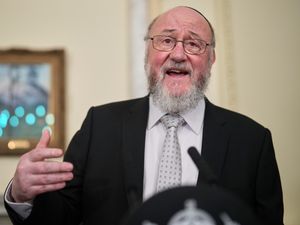
The UK’s chief rabbi has welcomed the decision by two of the country’s biggest police forces to arrest protesters over a controversial chant as “an important step towards challenging the hateful rhetoric” seen on Britain’s streets.
But the move – announced by Greater Manchester Police (GMP) and the Metropolitan Police in the wake of the Bondi Beach terror attack – has been decried as political repression by campaigners.
The heads of the two forces said their officers will “act decisively and make arrests”, adding the measures are designed to “deter intimidation”.
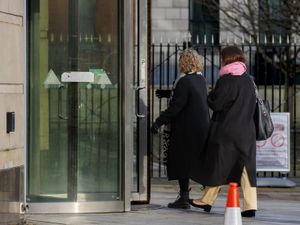
It comes as police were seen removing people from a pro-Palestine protest outside the Ministry of Justice building in Westminster on Wednesday night following chanting from the crowd.
It is unclear exactly what was said amid shouting from protesters, but officers walked into the crowd of around 100 people and took individuals away to police vans.
Chief Rabbi Sir Ephraim Mirvis had this week called for a crackdown on hate speech, saying it had to be made clear that chants such as “globalise the intifada” are “unlawful”.
Sir Ephraim, who is on his way to Australia to meet those impacted by the Sydney shootings said: “This announcement is a most welcome development, and an important step towards challenging the hateful rhetoric we have seen on our streets, which has inspired acts of violence and terror.”
As they made the announcement on Wednesday, Met Commissioner Sir Mark Rowley and GMP Chief Constable Sir Stephen Watson said circumstances have changed in the wake of the Bondi Beach mass shooting.
In a rare joint statement, they said: “We know communities are concerned about placards and chants such as ‘globalise the intifada’, and those using it at future protests or in a targeted way should expect the Met and GMP to take action.
“Violent acts have taken place, the context has changed – words have meaning and consequence.
“We will act decisively and make arrests.”
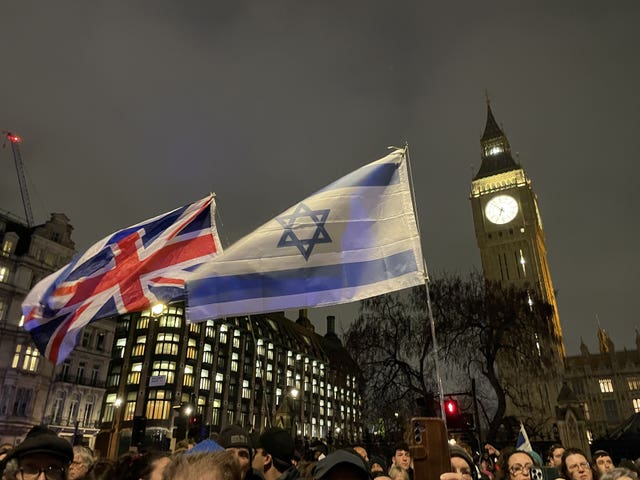
While the move was welcomed by Jewish groups, Ben Jamal from the Palestine Solidarity Campaign said it infringes on the right to protest, describing it as “another low in the political repression of protest for Palestinian rights”.
He said the word intifada “means shaking off or uprising against injustice” and said the “implication that slogans used to support the liberation of the Palestinian people are only open to interpretation by groups who have maintained complicit support for Israel’s oppression of the Palestinian people and denial of their rights, is deeply problematic”.
The American Jewish Committee describes the phrase as being “used by pro-Palestinian activists that calls for aggressive resistance against Israel and those who support Israel”.
But its meaning is contested, and protesters claim it is a call to “shake off” colonialism and for a peaceful resistance to Israel’s occupation of the West Bank and actions in Gaza.
A day after the Bondi attack, Sir Ephraim, who is also Chief Rabbi to the Commonwealth, told the Press Association the meaning of the chant “globalise the intifada” was seen in the Yom Kippur attack at the Heaton Park Synagogue in Manchester and the Hanukkah killings on the world-famous Sydney beach.
It is alleged that father and son Sajid and Naveed Akram opened fire on crowds of more than 1,000 people on Bondi Beach on Sunday as they celebrated the Jewish festival of light.
Sajid Akram, 50, was shot dead by police, while Naveed, 24, woke from a coma on Tuesday and was charged with a raft of offences including 15 counts of murder and committing a terrorist attack.
The first funerals of the victims took place on Wednesday, including that of London-born Rabbi Eli Schlanger.
The Community Security Trust, a charity which provides protection for Jews in Britain, said the police forces’ announcement comes “not a moment too soon” as it welcomed the “more robust response to violent language on protests”.
A spokesperson said: “This is a necessary and important first step to turning back this tide of violent incitement and we hope that police across the country, and the CPS, will follow suit.”
The Campaign Against Antisemitism said police chiefs “may finally be waking up”, adding they “have finally realised that words and chants have consequences” after “two years of repeatedly excusing genocidal rhetoric and failing to grasp how their inaction was fuelling extremism in this country”.
The Embassy of Israel in the UK welcomed the announcement but said it was “disappointing it has taken such a long time” and added it is hopeful “real action is now taken to stop this chant before it can lead to further radicalisation and violence against Jews”.
Prosecutors have said they will consider each case on its own merits, and go back to police with advice where there is not enough evidence to bring charges.
Britain’s human rights regulator, the Equality and Human Rights Commission, has said it will monitor closely how police forces enforce the decision to arrest people using the chant.