Kate bonds with toddlers as she learns about project to boost health visitors
The future Queen’s Royal Foundation Centre for Early Childhood has launched the programme with Anna Freud, a leading mental health charity.
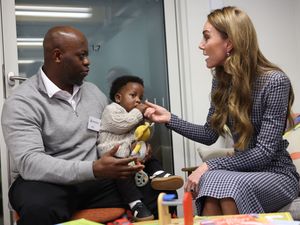
The Princess of Wales cooed over toddlers and held the fingers of a little boy when she met parents helping to shape a training curriculum for health visitors.
Kate met the mothers and fathers when she visited the mental health charity Anna Freud to learn about the project, and told the parents: “Thank you for being part of the programme, it really matters.”
The future Queen’s Royal Foundation Centre for Early Childhood has launched the programme with Anna Freud, a leading research and development organisation specialising in children and young people’s mental health based in central London.
The new training curriculum is being created for health visitors and is expected to be launched next year to help their work supporting the early social and emotional development of children.
The parents were enjoying a coffee break and playing with their children when Kate sat down and joined them, chatting to Andy Apraku, 41, a secondary school teacher from Croydon, south London, who was holding his eight-month-old son Judah.
Kate’s fingers were immediately held by the little boy and she rubbed his hand while chatting to Mr Apraku, a father-of-three, about the role of fathers, and at one point his son sucked her fingers.
After joking that his son was hungry, the secondary school teacher told her there was a need to “recognise fathers have a role, and are in the room”.
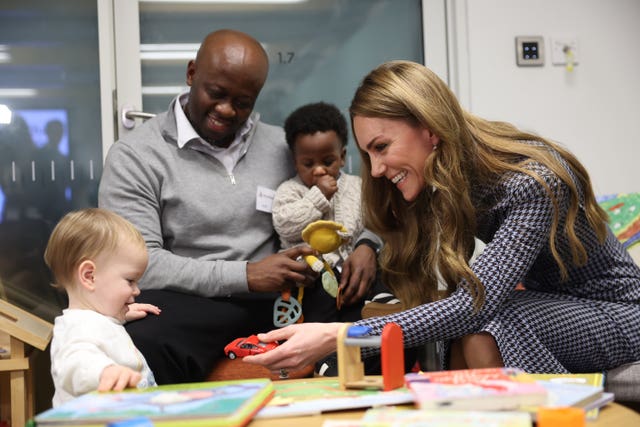
Kate also tried to make 13-month-old Amelia Baddeley smile when she caught the little girl glancing over as her mother Ella Baddeley, 20, from Reading watched.

Kate held out a red toy car as she tried to make friends with the toddler who wandered over and started to play with the princess.
During the visit the princess talked to other parents and grandparents working with Anna Freud and the Institute of Health Visitors to shape the new curriculum.
She also joined experts, academics, teachers and child psychologists having discussions about trusted relationships in childhood.
The institution which Kate supports as patron is named after Anna Freud, the pioneer of child psychoanalysis – and daughter of the famous psychoanalyst Sigmund Freud – who was instrumental in its creation.
She set up the Hampstead War Nurseries in 1941 in response to the social and emotional upheaval faced by children in wartime, and over the decades it developed into a centre of teaching and research and a major service provider.
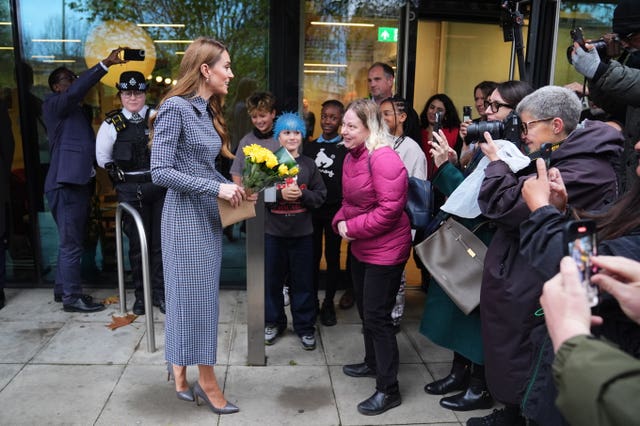
Before leaving, Kate went on a brief meet-and-greet with the public and chatted to some children from a neighbouring school.
Professor Eamon McCrory, Anna Freud’s chief executive, said about the new curriculum: “This programme is really focusing on how can we nurture and develop, healthy social and emotional development and those key skills that are the bedrock for future life.”
He went on to say: “The princess did mention this to me, she really sees the importance of having lived experience as part of any project or development because the parent’s voice is helping to make sure what we develop is accessible, that it’s relevant, that’s it’s needed.”