Migrants swell a vibrant landscape - we celebrate salmon runs and flocks of birds as Shropshire's wildlife comes to life this January
The New Year is at first seen as a re-birth, a fresh start before then seemingly to succumb to afeeling of dreariness and solemnity.
Well not when it comes to Shropshire’s wildlife! There is almostas much going on this month as there is in the summer time. All the winter migrants from birds tosalmon are here with us, bolstering the Salopian biomass considerably, writes Ben Waddams.
The moments we may look out over the fields, the parkland, the hedgerows or maybe theShropshire Hills, may well be framed by a frosty beauty or saturated with cold rain, but nonetheless, January is a month to get out there and enjoy the nature we have on our doorstep.
At the very least it is a month of suspension, before warmth begins to creep back in and other species awake.
As if with a mission to shake us from any blues, the nuthatch is one of the most distinctive woodlandcharacters at this time of year.
Stocky, confident, and surprisingly bold for such a small bird, it moves along trunks and branches with an assertive flick of its tail, often the first to investigate a feeder or a crevice in tree bark. January is not a time for subtlety; the nuthatch’s sharp calls echo through quietwoods, cutting through the winter air with a clarity that leaves no doubt about its presence.They are fiercely territorial, and you might see the flash of slate-blue wings as one chases off a rivalfrom a favourite feeding site.
The nuthatch’s methodical way of working over bark for insects, seeds,and cached nuts gives it an industrious air, a sense of steady purpose that feels perfectly suited tothe austerity in wild food this month.In contrast, the treecreeper is almost invisible unless you know how to look for it.
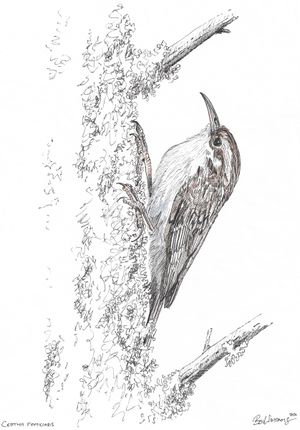
Where thenuthatch moves with confidence in all directions, even upside down, the treecreeper is a specialist inupward motion. It spirals up the trunk in tiny, delicate hops, using its stiff tail feathers for balance, itsfine curved bill probing into the smallest cracks.
January may seem like an odd month for such aprecise insect-hunter to thrive, yet its technique is so refined that it can glean enough winteringspiders, dormant larvae, and hidden eggs to survive.Away from the woods, Shropshire’s open fields and rough grasslands hold a different winter drama.

The grey partridge, once a common sight, has become increasingly scarce, but those that remainbring warmth to January’s muted colours. Their rounded shapes blend into the stubble, and theyoften move in coveys; tight-knit family groups that work as a unit. Winter is a harsh time for them;natural food sources are limited, and their ground-dwelling habits leave them exposed. Yet their behaviour in January demonstrates remarkable cohesion. A covey will feed together, rest together,and watch for predators collectively.
Their soft, rasping calls carry only a short distance, maintainingcontact without giving away their position.
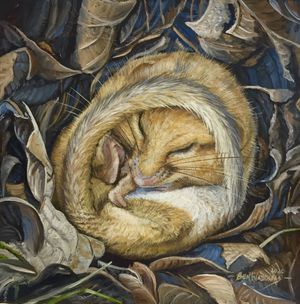
Hidden away from all this, the hazel dormouse is deep in a long sleep. January is one of the coldest,toughest months for this tiny mammal, and its strategy is simple: avoid the hardship entirely. While the birds fight for food and shelter, the dormouse curls into a tight golden ball beneath leaf litter,moss, or tucked at the base of hazel coppice stools.
Its heartbeat slows, its body temperature dropsdramatically, and it exists in a state that is almost outside of time.Chilly it may be, but hibernation in itself is not a strategy to escape the cold, but an adaptation tofood shortages in which low body temperature reduces energy consumption. Dormice rely on easilydigestible foods such as fruits, seeds, flowers, insects and fungi, all of which are scarce in winter.
So, rather than waste energy in fruitless searches, they weave a snug nest, often at the base of a tree orunder leaf litter, and switch all metabolic functions into standby mode.So let us not look at the New Year as a time of gloomy chill in the world outside, but as a season of clever strategies, evolved and honed over generations and where resilience is quiet, constant andoccasionally visible in all its intricacies to us.
*Ben Waddams is a wildlife artist. See his new work in Callaghans of Shrewsbury