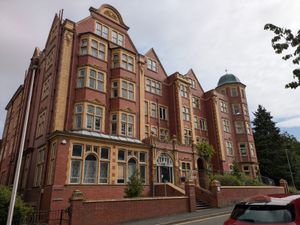
Concerned homeowner seeks permission to erect an iron fence outside his house in a historic Shropshire town to stop people walking on his drive after his cars have been scratched and dog poo left
A Shropshire homeowner wants to erect a metal fence around his house because people keep walking across his drive, scratching his cars and leaving dog poo
A planning committee may have to decide whether a homeowner can put an iron fence outside his house to stop people walking across the drive.
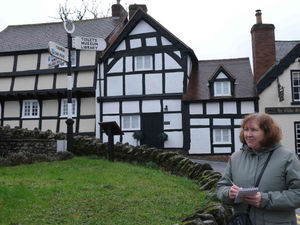
Peter Wight is seeking permission for the addition at Church House in Barrow Street, Much Wenlock.
In a statement submitted as part of the application to Shropshire Council, Mr Wight claimed there has never been a public right of way across the front drive, and none of the old archive maps show a marked footpath.
“We would like this fence to clearly mark the boundary of our property.” said Mr Wight.
“Currently, there is nothing to indicate this. Whilst we have put notices up, children on bikes, going to school, visitors, and dog walkers still use it as a short cut. Our cars have been scratched and faeces left for us to clear up.”
Mr Wight added that, while Wenlock Estates has a right of way for access, it has only used it twice in the last five years. However, neither it or its tenants are allowed to park vehicles on the drive, said Mr Wight.
“The cobbles were subject to a council grant, but at no stage was a condition put on about access,” said Mr Wight.
“There are 11 houses in Barrow Street with metal railings around their frontages. Church Walk is far too narrow to allow access for a fire engine or ambulance.”
Mr Wight added that he has always supported events in the town that require access across the drive.
He also said the gates will never be locked, and there is case law that says a gate can be be erected across a right of way as long as it does not amount to substantial interference.
The application was recently discussed by Much Wenlock Town Council.
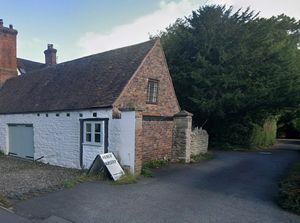
Members heard from The Reverend Matthew Stafford, whose church is near the property. He said that, despite the owners’ assurances over access to the cobbled area, the Parochial Church Council has concerns.
“It doesn’t follow that the future owners of Church House will necessarily follow the same view,” said Revd Stafford, adding that the area has a lot of history.
Viviene Bellamy, an historian who has lived in the town for about 35 years, said people have always walked across the drive.
“In times past, it was always a direct route for children from Barrow Street to go to the school,” she said.
“It seems a great pity that ancient paths and places should be lost.
“Old maps of the town show that in front of Church House, the street actually widened, and historically in Much Wenlock, the houses were built right onto the street. So, this is actually a denial of an historic aspect of Much Wenlock’s streetscene.”
Councillor David Fenwick said it was one of the most confusing applications he has dealt with.
“I absolutely accept how things used to be many years ago, but is that relevant today? We are not 100 per cent certain if there is a right of way.
“There is a precedent of putting gates above rights of way in the past. I fully understand the applicant’s concerns.”
However, Councillor Susan Crooke-Williams proposed that the council object, claiming that the transfer deed states a public right of way is allowed.
“If you choose to live on one of the main roads, people are going to stop, they are going to look,” she said.
“The title registered with the Land Registry gives people the right to go across the cobble stones, and although Mr and Mrs Wight might say they have never stopped that, going forward, that might always be the case.”
Her proposal was approved by the majority of councillors.