Noctilucent clouds: Spectacular rare space phenomenon sighted in UK - When can I see noctilucent clouds?
A Met Office video explains seven rare cloud types - including noctilucent clouds as they’re sighted in the UK.
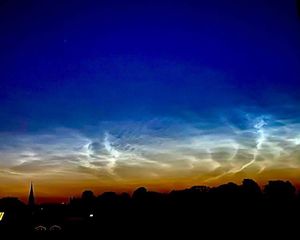
An incredible photograph shows noctilucent clouds in the UK.
Sachiko Hamada caught the stunning space phenomenon at 2:10am on July 8.
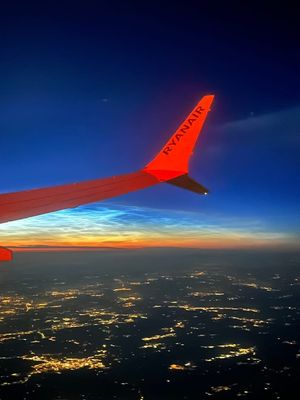
Rebecca Coates managed to photograph noctilucent clouds as she flew into the UK on June 28.
What are noctilucent clouds?
According to the Met Office, noctilucent clouds (“night-shining” clouds) are extremely rare collections of ice crystals that occasionally appear in late clear summer evenings after sunset, but before it gets completely dark. Noctilucent clouds often stay visible after dark with them still reflecting sunlight due to how high they are. They are higher up than any other clouds, occupying the layer of atmosphere known as the Mesosphere, near the edge of space, and are only seen at latitudes between 45°N and 80°N.
Why are noctilucent clouds so rare?
Noctilucent clouds need water vapour, dust, and very low temperatures to form. Low temperatures are easily attainable in the Mesosphere, however water vapour and dust are in short supply.
What do noctilucent clouds look like?
The Met Office says they often closely resemble thin streaky cirrus, though other shapes are often seen. They are usually blue or silver in colour, but are sometimes orange or red.
When can I see noctilucent clouds?
In the Northern Hemisphere, noctilucent clouds can be visible from the end of May to the start of August, with sightings more likely in June and July.
Royal Museums Greenwich advise you look up an hour or two after sunset or before sunrise from a place with a flat horizon and a clear view of a wide area of sky.
In the evening, look west around 40 minutes after the Sun has set.
In the early morning, look towards the northeast where the Sun will soon be rising, and aim your gaze high up in the sky.