Bangladesh’s first woman prime minister Khaleda Zia dies aged 80
The country’s interim government announced a three-day mourning period.
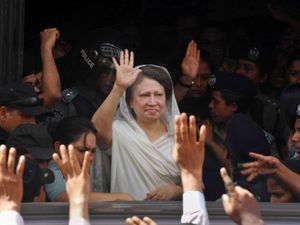
Former Bangladeshi prime minister Khaleda Zia, whose arch-rivalry with another former premier defined the country’s politics for a generation, has died, her Bangladesh Nationalist Party said in a statement.
Ms Zia, who died aged 80, was the first woman elected prime minister of Bangladesh.
Bangladesh’s interim government announced a three-day mourning period. A general holiday was also announced for Wednesday when Ms Zia’s funeral prayers are scheduled to be held in front of the country’s national parliament building in Dhaka.
Bangladesh’s interim leader Muhammad Yunus issued a statement on Tuesday citing Ms Zia’s contributions to the country.

“Her role in the struggle to establish democracy, a multi-party political culture, and the rights of the people in Bangladesh will be remembered forever,” Mr Yunus said.
Indian prime minister Narendra Modi offered condolences in a statement on Tuesday, noting that “as the first woman prime minister of Bangladesh, her important contributions toward the development of Bangladesh, as well as India-Bangladesh relations, will always be
remembered”.
Sajeeb Wazed, son of former Bangladesh prime minister Sheikh Hasina, said in a statement on Tuesday that Ms Zia’s demise “will leave a deep impact on the country’s (democratic) transition”.
“She will be remembered for her contributions in nation building but her death is a blow to stabilise Bangladesh,” Mr Wazed, whose mother was Ms Zia’s greatest political rival, said.
Ms Hasina issued a statement from exile in India saying Ms Zia’s death was “an irreparable loss” for politics in Bangladesh and recalled her contributions in establishing the nation’s democracy.

Ms Zia had faced corruption cases she said were politically motivated, but in January 2025 the supreme court acquitted Ms Zia in the last corruption case against her, which would have let her run in February’s general election.
The Bangladesh Nationalist Party (BNP) said that after she was released from prison due to illness in 2020, her family sought permission for treatment abroad at least 18 times from Ms Hasina’s administration, but the requests were rejected.
Bangladesh’s early years of independence, gained in a bloody 1971 war against Pakistan, were marked by assassinations, coups and countercoups as military figures and secular and Islamic leaders jockeyed for power.
Ms Zia’s husband, president Ziaur Rahman, had grabbed power as a military chief in 1977 and a year later formed the BNP. He was credited with opening democracy in the country but was killed in a 1981 military coup.
Ms Zia’s uncompromising stance against the military dictatorship helped build a mass movement against it, culminating with the removal of dictator and former army chief HM Ershad in 1990.

Ms Zia’s opponent when she won her first term in 1991 and in several elections after that was Ms Hasina, the daughter of independence leader Sheikh Mujibur Rahman, who was assassinated in a 1975 coup.
Ms Zia was criticised over an early 1996 election in which her party won 278 of the 300 parliamentary seats during a wide boycott by other leading parties including Ms Hasina’s Awami League, which demanded an election-time caretaker government. Ms Zia’s government lasted only 12 days before a nonpartisan caretaker government was installed and the new election was held that June.
Ms Zia returned to power in 2001 in a government shared with the country’s main Islamist party, Jamaat-e-Islami, which had a dark past involving Bangladesh’s independence war.
In 2004, Ms Hasina blamed Ms Zia’s government for grenade attacks in Dhaka that killed 24 members of her Awami League party and wounded hundreds of people.
Ms Hasina narrowly escaped the attack, which she characterised as an assassination attempt, and subsequently won the 2008 general election.
Ms Zia’s party and its partners boycotted the 2014 election in a dispute over a caretaker government, giving a one-sided victory to the increasingly authoritarian regime of Ms Hasina.

Her party joined the national elections in 2018 but boycotted again in 2024, allowing Ms Hasina to return to power for a fourth consecutive time through controversial elections.
Following Ms Hasina’s removal in 2024, the Yunus-led interim government finally allowed Ms Zia to leave for treatment abroad. She went to London in January and returned to Bangladesh in May.
Ms Zia was silent about politics for years and did not attend political rallies, but she remained the BNP chairwoman until her death.
She was last seen at an annual function of the Bangladesh military in Dhaka Cantonment on November 21, when Mr Yunus and other political leaders met her. She was in a wheelchair.
She is survived by Tarique Rahman, her elder son and heir apparent in the political dynasty. Her younger son, Arafat, died in 2015.