Living hostages and Palestinian prisoners released as part of ceasefire in Gaza
A convoy has left Ofer prison with Palestinian prisoners as part of the exchange, as US President Donald Trump prepared to address the Knesset.
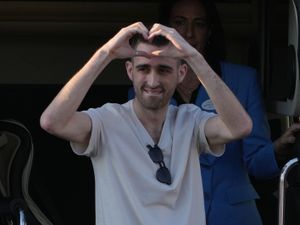
Hamas has released all 20 remaining living hostages held in Gaza as part of a ceasefire, pausing two years of war that pummelled the territory, killed tens of thousands of Palestinians, and left scores of captives in militant hands.
Tens of thousands of Israelis watched the hostage transfers at public screenings across the country. In Tel Aviv, families and friends of the hostages broke into wild cheers as television channels announced that the first group was in the hands of the Red Cross.

The freed hostages, all men, were later reunited with their families and footage released by Israeli authorities showed tearful reunions, including one showing 28-year-old twins Gali and Ziv Berman embracing as they were reunited.
Hostages previously released had said the twins from Kfar Aza were held separately.
The Israeli military said Monday that it was escorting the bodies of four deceased captives who had been held by Hamas in Gaza. It was not immediately clear when the remaining 24 deceased captives would be handed over by Hamas.
Palestinians in the occupied West Bank rejoiced as buses carrying dozens of released prisoners from Ofer Prison arrived in Beitunia, near Ramallah, as Israel began releasing more than 1,900 prisoners and detainees as part of the ceasefire deal.
The prisoners include 250 people serving life sentences for convictions in attacks on Israelis.
Later, giant crowds gathered to greet buses carrying other prisoners arriving at Nasser Hospital in Gaza’s southern city of Khan Younis.

More than 150 of those freed were sent to Egypt by Israel and arrived at Gaza’s Rafah crossing with Egypt early Monday afternoon
The freed men, with their heads shaved, descended from the bus, flashing V-for-victory signs; some were lifted up onto the shoulders of the crowd, while others sank into chairs nearby, exhausted.

Kamal Abu Shanab, a 51-year-old Fatah member from the West Bank town of Tulkarem, said: “It was an indescribable journey of suffering — hunger, unfair treatment, oppression, torture and curses — more than anything you could imagine.”
His face gaunt, he said he lost 139 pounds (59 kilograms) in prison.
Mr Shanab’s niece, Farah Abu Shanab, said: “We don’t recognise him. He’s not the person we knew. Our uncle doesn’t look like our uncle.”

Earlier, while Palestinians awaited the release of hundreds of prisoners held by Israel, an armoured vehicle flying an Israeli flag fired tear gas and rubber bullets at a crowd. As drones buzzed overhead, the group scattered.
The tear gas followed the circulation of a flier warning that anyone supporting what it called “terrorist organisations” risks arrest.
Israel’s military did not respond to questions about the flier.

While major questions remain about the future of Hamas and Gaza, the exchange of hostages and prisoners has raised hopes that it marks the end of the deadliest war ever between Israel and the militant group.
The ceasefire is also expected to be accompanied by a surge of humanitarian aid into Gaza, parts of which are experiencing famine.

US President Donald Trump is in Israel to celebrate the US-brokered ceasefire and hostage deal between Israel and Hamas before continuing on to Egypt for a key summit that he hopes will solidify an end to the war and pave the way for a more durable peace in the Middle East.
Israeli Prime Minister Benjamin Netanyahu pledged that he was “committed to this peace” in a speech to the Knesset, the Israeli parliament.
Mr Trump also addressed the Knesset, telling Israeli officials that their country had no more to achieve on the battlefield and must work towards peace after two years of war against Hamas and conflicts with Hezbollah and Iran.
“Generations from now, this will be remembered as the moment that everything began to change,” he declared.

“Israel, with our help, has won all that they can by force of arms,” Mr Trump said.
“Now it is time to translate these victories against terrorists on the battlefield into the ultimate prize of peace and prosperity for the entire Middle East.”
Later, Mr Trump will head to Egypt, where he and Egyptian President Abdel-Fattah el-Sissi will lead a summit with leaders from more than 20 countries on the future of Gaza and the broader Middle East.
Mr Netanyahu will not attend the summit, despite Cairo earlier announcing that the Israeli prime minister would take part.
In a statement, Mr Netanyahu’s office said that he had been invited by Mr Trump to participate in the meeting of world leaders but declined “due to the timing’s proximity to the beginning of (a Jewish) holiday.”