Egg hunt reveals record numbers for rare butterflies after hedges grow wild
Boost to brown hairstreak butterfly in south Wales after landowners change hedgerow regime.
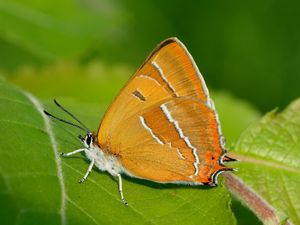
Landowners have given a rare butterfly a major boost by letting their hedgerows grow wild, conservationists have said.
Brown hairstreak butterflies have laid record numbers of eggs in parts of south Wales after hedgerows were protected from annual “flailing” cuts that destroyed a key habitat for them, Butterfly Conservation said.
While the charity says it does not want to stop anyone managing their hedges, it wants to encourage more landowners to try “cutting back on their cutting back” to help a host of wildlife from butterflies to moths, dormice and birds.

The brown hairstreak was once much more common across the UK, but has seen numbers fall significantly as a result of farmers and landowners removing hedgerows and “flailing” to cut hedge growth back, Butterfly Conservation said.
The butterfly will only lay its eggs on young shoots of blackthorn – a common bush in hedgerows, which are destroyed by flailing.
While the species was present in most of the Twyi valley as recently as 2010, it disappeared almost entirely in the following decade, and Butterfly Conservation’s south Wales branch believes that is due to an increase in annual mechanical flailing of hedges and scrubby areas.
But work with two partners – the National Trust and the South Wales Trunk Road Agent – saw both organisations reduce the amount they cut back their hedgerows, allowing for record numbers of the rare butterfly’s eggs to survive.
They protected their sites from annual flailing and had more blackthorn planted on them.

As a result, volunteers who go out each year in December or January in Carmarthenshire’s Tywi valley – armed with magnifying glasses to hunt for the tiny white eggs of the brown hairstreak in hedges – have clocked up record tallies this winter.
Richard Smith, who has volunteered with Butterfly Conservation’s south Wales branch for more than 30 years, said: “The volunteer team are really excited to find that, after a decade of heartache for brown hairstreaks in Carmarthenshire’s Tywi valley, there is at last signs of an upturn.”
While the sites protected from annual flailing have seen a 50% increase in eggs this winter, another group of fields nearby which were unmanaged for four years have now been “severely flailed”, with a drop of 60 eggs found a year to just four, he added.
Dan Hoare, Butterfly Conservation’s director of nature recovery, said: “We don’t want to stop anyone managing their hedgerows, but we would love more landowners to try cutting back on their cutting back.
“If hedgerows are only trimmed once every two years, or even every three years, it could make an enormous difference to the survival of the brown hairstreak and help many other species as well.
“The lovely brown hairstreak is an indicator of getting that balance right.”
He said that thriving populations of brown hairstreaks were a sign of healthy hedges, which in turn delivered a range of benefits as food sources to a host of wildlife, shelter for creatures from dormice to yellow hammers and pathways through the countryside for bats and birds.

Grasses and flowers at the base of hedges are also good for amphibians, reptiles, farmland birds, small mammals and insects, while hedgerow trees increases the abundance and diversity of larger moths, he told the Press Association.
“The simple message for brown hairstreaks is that cutting hedges less often is better.
“But there is a wealth of evidence that taking a range of other simple steps, from planting hedgerow trees and filling in gaps in established hedges, to widening field margins next to the hedge and planning hedgerow management at the landscape scale with your neighbours, can give wildlife a major boost,” he added.