Northern Ireland was on ‘cusp of new beginning’ with Stormont return in 2000
Officials held an away-day ahead of the return of the powersharing institutions in May 2000.
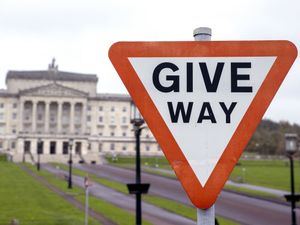
Northern Ireland was on the “cusp of a new beginning” with the return of the Stormont political institutions, officials predicted in 2000.
A briefing document among declassified files at the Public Record Office in Belfast said the return of devolution put a premium on the need to provide “joined-up and more open government”.
The powersharing institutions were established following the 1998 Good Friday Agreement and ministers held their first Executive meeting in December the following year.

However, in February 2000 the institutions were suspended by then Secretary of State Peter Mandelson due to a lack of progress on IRA decommissioning.
After a statement from the IRA pledging to put arms “completely and verifiably” beyond use, the Assembly and Executive were restored in May 2000.
Ahead of the return, an away-day for senior civil servants was held at a hotel in Co Antrim with the aim of overseeing the establishment of the OFMDFM (Office of First Minister and Deputy First Minister) as a department.
A briefing paper for the meeting examined the political context that the new department would operate in.
The paper said: “Northern Ireland is on the cusp of a new beginning.
“It is a beginning that offers the real prospect of enduring political stability and self-government.
“It is a new start that provides society with the opportunity to undergo the dynamic changes that derive from global forces and from specific domestic factors.”
Officials were told devolution would bring “many challenges and threats”.
The paper said: “Threats from those opposed to the process and major challenges to heal society, tackle polarisation and deal with the deep distrust built up over 30 years of conflict.
“The nature of the involuntary coalition of four very disparate parties will present difficulties.
“There will be high pressure on returning ministers (and officials) and high expectation from the public.
“The level of constitutional change within NI is significant with the Executive, Assembly, NSMC, BIC, BIG and Civic Forum all seeking to establish their roles and identities.
“At a UK level constitutional change, most notably devolution, is still outworking. It offers Northern Ireland a basis for establishing its own relationships with other parts of the UK and with the EU.”
It added that the nature of devolution puts a premium on the need to provide “joined-up and more open government”.
The political institutions were subsequently suspended for two short periods in 2001 amid ongoing disputes over decommissioning before collapsing in 2002 for five years after police raided Sinn Fein’s Stormont offices as part of an investigation into allegations republicans were spying on the government.