Nature reserve announces expansion which could help capercaillie
RSPB Scotland announced the news as RSPB Abernethy celebrates its 50th anniversary.
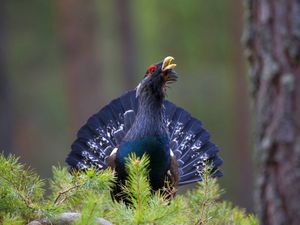
A nature reserve is expanding in a move which it is hoped will help species such as the endangered capercaillie.
RSPB Scotland announced that the purchase of new land at RSPB Abernethy nature reserve has been completed as the reserve celebrates its 50th anniversary.
The reserve includes Loch Garten where in 1954 the first confirmed pair of breeding ospreys to nest in the UK were spotted after the species went extinct in 1916.
Since acquiring the loch and surrounding woodland in 1975, RSPB Scotland has expanded the land it manages to create the 14,000-hectare RSPB Abernethy nature reserve which is renowned as a place to see ospreys.
It has now completed the purchase of 33 hectares of land at Lower Dell, near the village of Nethy Bridge, bordering the current boundary of the nature reserve.
This will allow it to expand cattle grazing at the reserve which the charity said will bring benefits such as boosting the growth of blaeberries – a key plant for capercaillies.
Ben Oliver-Jones, senior site manager at RSPB Abernethy, said: “Cattle grazing across a range of habitats at Abernethy is central to our vision for ecological restoration and it wouldn’t be possible without local graziers, who bring cattle to the reserve.
“Cattle in the forest replicate the grazing behaviour of extinct herbivores such as aurochs and improve conditions for birds such as capercaillie and black grouse.
“The purchase of the land at Lower Dell will help us bring more cattle into the forest by making it easier for graziers to manage herds moving in and out of the area.
“Crucially, the use of No-Fence GPS collars on our cattle allows us to manage herds without the need for costly and intrusive fencing in the forest.”
With just over 500 capercaillies left in the UK they are considered to be at risk of extinction in the UK.
The grazing action of the cattle helps as new growth on blaeberry shrubs provides an important source of food for adult birds while young capercaillie chicks are fuelled in their first few weeks by insects which feed on the plants.
The cattle also break up thick heather which makes it easier for the chicks to move through the undergrowth, stay close to their mothers and stay dry during the spring if it is wet.
After their return in 1954 ospreys from Scandinavia naturally recolonised Loch Garten.
RSPB Scotland said that as many as 400 breeding pairs of the birds now return to the UK each year after spending the winter in West Africa.