
Light shines on Shropshire church solar panels
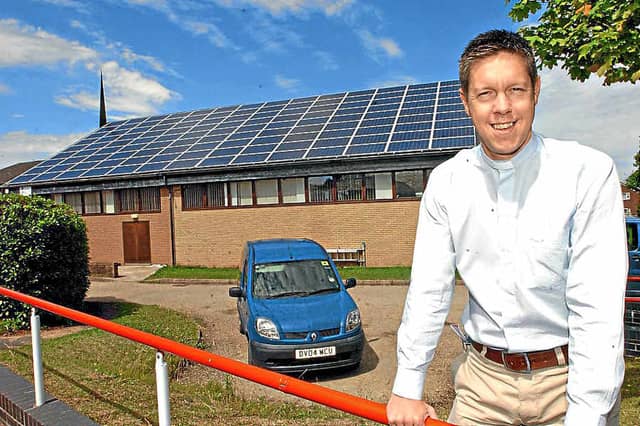

St Alkmund's Cathedral is a building steeped in history. Part medieval, part Georgian, its 184ft spire has towered over Shrewsbury for half a millennium.
But while the church of St Alkmund can trace its roots back more than 1,100 years, its electricity supply comes from very much a 21st century source.
In 2008, the Rev Richard Hayes – the vicar at the time – was the driving force behind St Alkmund's becoming the first church in Shropshire to install solar panels on its roof. The 22 photovoltaic panels cost £24,000 to install, with half of the money coming from a government grant, a quarter coming from energy company EDF, and with the Diocese of Lichfield paying the remainder.
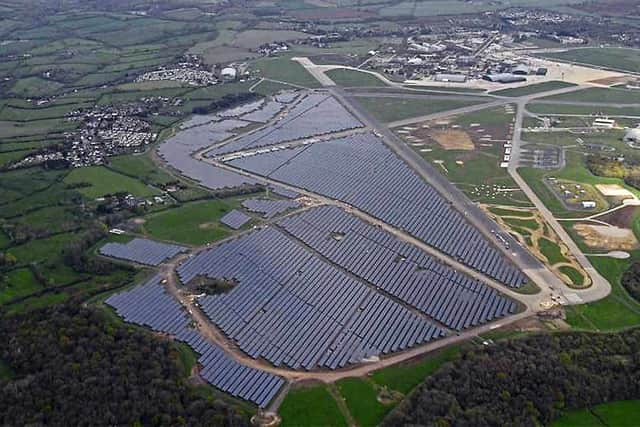
Imagine a power station able to provide enough electricity to supply 22,000 homes, that produces zero emissions, and that does not require any imported coal or gas.
It sounds like a distant pipe-dream, the sort of imagery propagated by the green energy lobby to persuade the Government to part will millions of pounds for a new project.
But that technology is already with us, and operating in the English countryside as part of a government-backed scheme.
Take a long car or train journey across the British countryside and there is every chance that, at some point, you will catch the glint of sunlight shining off a solar panel.
The solar farm at the former RAF Lyneham airbase in Wiltshire is thought to be the biggest in the land, producing nearly 70mW of electricity, and is being hailed by supporters of the solar industry as a technological milestone. The lack of fanfare surrounding the site is seen by some as a symbol of how solar farms are still something of a political hot potato, particularly when built in rural areas.
Industry spokesman Finlay Colville: "In any other solar market globally, and at any other time in the UK's solar history before 2013, the realisation of a 70mW solar farm would have been headlined as a monumental achievement.
"However, the fact that this has been kept under wraps so much since March may simply be a reflection of the troubled relationship between the UK solar industry and a government that all too often has cut incentives whenever the industry has been highly successful in rolling out solar deployment."
Certainly, in Shropshire there have been concerns among many residents about the proliferation of solar farms in rural areas.
These days, the solar industry is big business. During this year's brief heatwave, solar energy was said to be supplying 15 per cent of the UK's electricity. Government subsidies have helped with the creation of more than 700,000 solar farms all over Britain.
However, many have voiced concerns that the shiny panels are defacing Shropshire's green and pleasant land, and are also taking up valuable sites that could be used for agriculture.
Last month, plans for a 33-acre plant on the outskirts of Ludlow was rejected by councillors, to the joy of countryside campaigners, who said it would have a negative effect on farming, tourism and heritage.
It is the fifth major solar farm project to be rejected this year.
Peter van Duijvenvoorde, chairman of the Save South Shropshire Hills campaign group, says that while there may be a place for such developments on brownfield sites, such schemes do not belong in rural Britain.
"We are horrified at the continuing threats to our countryside," he says.
"It is time for our politicians to more strongly encourage the deployment of solar panels on brownfield sites and commercial buildings and to actively discourage proposals for solar factories on productive greenfield sites."
He says his group is not against solar energy, and has no problem with recent proposals such as plans to place 440 solar panels on the roofs of poultry shed roofs at Fishmore Farm, nor 19,200 panels at a former quarry site at Bromfield, both on the outskirts of Ludlow and both designed to directly supply businesses at the site with the energy they generate.
It is one of a small but growing number of churches which are looking to the skies to source their energy.
"The planet is obviously suffering and we wanted to do our part and go green," he says.
At the time, Mr Hayes hoped that St Alkmund's would take the lead that other churches would follow, but installing panels on some of Shropshire's most historic buildings was never going to be a simple affair.
Ruth Knight, environmental policy officer at Church Care, a division of the Archbishop's Council, says there has been a slow but steady increase in the number of churches opting for solar power, but says it was a fine balance between preserving the fabric of historic buildings and developing a sustainable energy supply.
"It's quite important to the church to reduce our carbon footprint," she says. "There are around 200 churches nationally which have solar panels now. They are very much dealt with on a case-by-case basis by historic England. We have to look at things like whether the roof is strong enough to support them.
At the moment, St Alkmund's is one of three churches in Shropshire with solar panels, the other two being Christ Church in Little Drayton, and Christ Church in Bayston Hill.
St Laurence's in Ludlow is also looking to install them, and over the border in Herefordshire St Michael and All Angel's Church in Ledbury has been running on solar power for nearly five years.
For many, the long-term cost-savings coupled with the environmental benefits make an overwhelming case for churches to go solar. But anyone who has followed the controversies surrounding plans for solar farms around the Shropshire countryside will know there is far more to it than simply bolting a few panels onto the roof.
In the case of St Alkmund's, a new roof was being erected anyway, so it made sense to fit the panels while the work was being carried out. But great care had to be taken to ensure the alterations were sympathetic to the architecture of the Grade II listed building.
"It's a very old building, so we had to ensure that the panels could not be seen from the ground," Mr Hayes says. "The panels were installed on part of the pitched roof which were hidden behind a parapet. I don't want things to be spoiled visually, but at the same time we've got to think about our grandchildren," he says.
In 2009, St Alkmund's hosted an open day where other churches were invited to learn about the panels, but six years on, there is still a fine line to be trodden between churches reducing their carbon footprint and the requirements on conservation groups. And, Mr Hayes adds, the grants which St Alkmund's was able to benefit from are not available today.
Not that there were any such problems at Christ Church, just three miles away, down the A5112 at Bayston Hill. Being a modern building, the planning process was little different than for any other installation,and in 2011 the church installed 126 solar panels.
The Rev Tim Lomax says he is delighted with the results.
"We wanted to install the solar panel system for a number of reasons, one of the main ones being to reduce our carbon footprint, and to show in a really positive way how we can help to care for God's wonderful creation," he says.
"This scheme will save 10,920kg of carbon dioxide each year, and we hope that other churches and church buildings will follow our example.
"The Diocese of Lichfield has been generous in giving us a loan to cover the costs of installation. This will be paid back fully in less than 10 years from the feed-in tariff, which is the income we receive from our electricity supplier for generating our own power."
At Ledbury, 54 panels were installed on the roof of St Michael and All Angels' in December 2010, and were switched on the following January. Like at St Alkmund's, they are invisible from the ground, and feed electricity into the national grid to generate the church an income.
Diana Evans, Historic England's head of place of worship advice, said: "We approach every request for advice on a case-by-case basis, taking into account the wider historic environment and the impact the proposals would have on other people's enjoyment of it. The number of buildings with solar panels demonstrates that there are often no issues raised by Historic England but sometimes there are concerns which we are duty bound to raise."
Some churches have been able to get round the difficulties by installing the panels on roofs of less prominent buildings such as church halls, while others have gone for less visually intrusive solar tiles. Anni Holden, of Hereford Diocese, says that the east-west orientation of most churches makes them ideal locations for solar panels, but says a combination of cost and planning regulations means that it is still only a minority that are able to install them.
"With Ledbury, that is a very big church, it has lots of different rooms, and it is easy to hide the panels, but with many village churches they are very conspicuous," she says.
Mrs Holden points out that for the majority of rural parish churches, electricity consumption is not a major issue. But she says: "Ledbury is a huge tourist attraction, it has exhibitions on, and it is open all the time."
She says, though, that the diocese believes that Historic England and other conservation bodies should review its position on panels.
"At the moment it is very difficult for most churches to install solar panels," says Mrs Holden.
"That is a great shame."