Birmingham New Street Station declared busiest outside London - but our top 50 lists reveal some in our region are virtually deserted
Birmingham’s New Street Station has retained its position as Britain’s busiest outside London.
New figures reveal it stayed in 13th place in the rankings, but that its numbers have increased significantly compared to last year.
It saw more than 36.6 million people pass through in 2024-5, more than three million up on the previous year.
The figures reflect the mass return to the railways following a slump that came during the Covid lockdowns and the subsequent change in work and social patterns.
The statistics show that New Street has almost 10 million more passengers than Manchester Piccadilly and almost 11 million more than Glasgow Central, both stations that are linked to it via the West Coast mainline.

In contrast, some rural stations in our region made into the top 50 least used stations.
Llangynllo in Powys has just 752 passengers in the year, Llanbister Road 990 and Cilmeri 1,066. The quietest station was Elton & Orston in Nottinghamshire, with just 68 passengers through the whole year.
London’s Liverpool Street retained its title of the UK's busiest railway station.
The estimated number of entries and exits at Liverpool Street in the year to the end of March was 98 million, regulator the Office of Rail and Road (ORR) said.
That is up 3.7 per cent from 94.5 million a year earlier.
London Waterloo was the second busiest station in 2024/25, with 70.4 million entries and exits. It was ranked number four during the previous 12 months.
The station was the busiest in the UK for all but one of the 18 years up to and including 2021/22, but lost its title when the Elizabeth line opened.
London Paddington (69.9 million entries and exits) and Tottenham Court Road (68.1 million entries and exits) were ranked third and fourth respectively.
They are both served by the Elizabeth line, which stretches from Reading in Berkshire and Heathrow Airport in west London to Abbey Wood in south-east London and Shenfield in Essex .
London Bridge secured fifth place, with 54.7 million entries and exits.
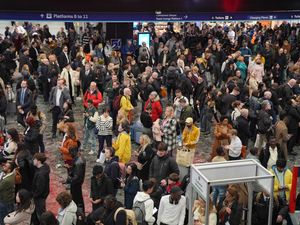
Euston Station, which is London’s main link to the West Midlands, came 10th on the list with more than 40 million passengers, up from 36 million the year before.
The busiest stations in England outside London were Birmingham New Street (36.6 million entries and exits), Manchester Piccadilly (27.4 million) and Leeds (27.3 million).
The leader in Scotland was Glasgow Central (25.3 million), while Cardiff Central (12.5 million) took top spot in Wales .
A total of 1.73 billion passenger journeys were made in the year to the end of March, up seven from 1.61 billion in the previous year, the ORR said.
Elton and Orston in Nottinghamshire, which was the least-used station, is served by one East Midlands Railway train per day in each direction between Mondays and Saturdays. One runs to Nottingham, while the other takes passengers towards Skegness. No trains call at the station on Sundays. The station is unstaffed and has no seating area or toilet.
Llangynllo Station, which is operated by Transport for Wales, sits near Knighton and offers picturesque views but little else. The train firm lists its only ‘facility’ as a bench for passengers to sit on and it has little more than one service each way a day.
Railway stations are often kept open despite being rarely used because it is easier to arrange for a train to stop infrequently than obtain permission for closure.
Estimates of entries and exits are largely based on ticket sales.
Network Rail, which owns London Liverpool Street, wants to redevelop the Grade II listed site as part of a £1.2 billion project, which would involve building a mixed-use 97-metre tower block over the concourse.
A now-scrapped previous plan for a 108-metre tower block sparked criticism from public figures such as broadcaster Sir Stephen Fry and artist Tracey Emin .
The City of London Corporation is expected to make a decision next year on whether the latest proposal can go ahead.
Busiest stations:
The list reads, from left to right: name of station and location; total number of passenger entries and exits in 2024/25; (in brackets) total number of entries and exits in 2023/24 plus ranking in 2023/24.
1 London Liverpool Street: 98,015,658 (2023/24: 94,499,824; 1st)
2 London Waterloo: 70,389,546 (62,525,274; 4th)
3 London Paddington: 69,897,084 (66,859,098; 2nd)
4 Tottenham Court Road: 68,133,826 (64,219,040; 3rd)
5 London Bridge: 54,685,648 (50,045,010; 7th)
6 London Victoria: 53,784,358 (50,829,676; 6th)
7 Stratford, London: 51,473,518 (56,570,866; 5th)
8 Farringdon, London: 50,171,290 (46,049,862; 8th)
9 Bond Street, London: 42,752,242 (38,307,986; 9th)