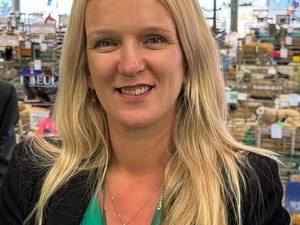
Telford grandmother's joy after pioneering brain operation
A grandmother of nine has become the first person in Europe to undergo a life-saving operation.
Maureen Lansdale, from Telford, underwent treatment at the Queen Elizabeth Hospital Birmingham last week after suffering intense headaches and temporary memory loss.
These disabling symptoms were caused by an abnormality in her brain, called a vascular malformation, which was growing in size and prevented her body from functioning properly.
The abnormality located at the base of Maureen's brain could spontaneously bleed at any moment, which could have led to a stroke.
Mrs Lansdale, 75, said: "I suffered terrible headaches. Sometimes the pain was so bad I wondered how my head could stand it. I thought it might explode."
After over a year of struggling with crippling symptoms, her life was changed when she underwent endoscopic surgery at the QE to remove the malformation.
This is the first time in Europe that a vascular malformation has been removed through this minimally invasive technique.
Mrs Lansdale said: "I didn't want my illness to win, but I was forced to spend a lot of time in bed. Surgeons tried to remove the aneurysm by accessing it through the groin, but they found the risk of blindness was too high.
"My only other option was to have a craniotomy, which I was worried about because it is such an invasive procedure.
"Luckily Dr Paluzzi had an alternative. He told me about a new way to remove the abnormality which had never been done at the QE before, or even in Europe.
"I wasn't scared though. It might sound strange but I knew I was going to survive."
The endoscopic technique involves surgically removing the vascular malformation by using the nostrils as "key holes".
Dr Alessandro Paluzzi said: "Maureen's aneurysm was located at the base of her brain, which meant the procedure didn't require any manipulation of normal brain, leading to a better outcome, faster recovery and no visible scars.
"Using the nostrils as natural corridors to the malformation, we were able to surgically remove the aneurysm in a much less invasive way." Just one week after surgery, the mother of four is set to return home.
She said: "It's like getting my life back! This is the first time in over a year that I've had a break from the pain. I can't wait to make up for lost time."
Now Mrs Lansdale is backing QEHB Charity's Brain Surgery Appeal, which aims to raise £250,000 to buy three pieces of new equipment that will allow more patients to access the non-invasive surgery.