Top US commander says campaign against Iran ‘ahead or on plan’
Israeli military began what it called ‘a wide-scale wave of strikes targeting Iranian terror regime infrastructure’ early on Monday.
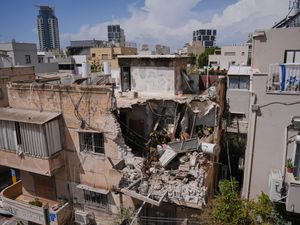
The top commander of the US military’s Central Command said the campaign against Iran is “ahead or on plan,” as the Israeli military began what it called “a wide-scale wave of strikes targeting Iranian terror regime infrastructure” early on Monday.
As US President Donald Trump’s deadline on opening the Strait of Hormuz approaches, Iran on Monday threatened to attack Middle East electrical plants powering American military bases.
US Navy Admiral Brad Cooper gave his first one-on-one interview of the war to the Farsi-language satellite network Iran International, which aired it early on Monday.
He said Iran’s continued attacks on Gulf Arab states and the wider Middle East region put civilians at risk and that the US and Israel were targeting missile and drone manufacturing sites as well.
“We’re also going after the manufacturing,” he said. “So it’s not just about the threat today. We’re eliminating the threat of the future, both in terms of the drones, the missiles, as well as the navy.”

Mr Cooper also said it is not the time for the Iranian public to come to the streets, although both Israel and the US have said they hope the Iranian public would topple the country’s theocracy as a result of the strikes.
“They’re launching missiles and drones from populated areas and you need to stay inside for right now,” he said. “There will be a clear signal at some point, as the president has indicated, for you to be able to come out.
“They’re operating in a sign of desperation. In the last couple of weeks, they’ve attacked civilian targets very deliberately, more than 300 times.”
He also noted the slowdown in Iranian incoming fire across the Middle East as the war has entered its fourth week.
“At the beginning of the conflict, you saw large volumes in the dozens of drones and missiles,” Mr Cooper said.
“You no longer see that. It’s all one or two at a time.”
Israel did not elaborate on the latest strikes, but Iranian media reported Tehran was being targeted early on Monday without identifying any locations.
The previous day, Tehran warned it could attack US and Israeli energy and infrastructure assets if Israel or the US attempted to follow through on President Donald Trump’s threat that the US would “obliterate” Iran’s power plants if it did not fully open the Strait of Hormuz.
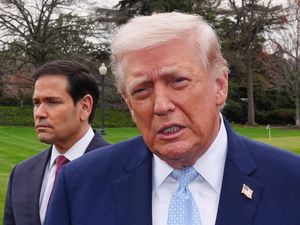
Mr Trump — who is facing increasing pressure at home to secure the strait as oil prices soar — issued the ultimatum in a social media post while he spent the weekend at his Florida home.
A statement from Iran’s paramilitary Revolutionary Guard, read out on state television on Monday morning, marks the latest attempt by Tehran to try to explain its attacks on the Gulf Arab countries.
“What we have done is to announce our decision that if the power plants are attacked, Iran will retaliate by targeting the power plants of the occupying regime and the power plants of regional countries that supply electricity to US bases, as well as the economic, industrial and energy infrastructures in which Americans have shares,” the statement said, referring to Israel as an “occupying regime.”
“Do not doubt that we will do this.”
The US president wrote on his Truth Social website early on Monday: “PEACE THROUGH STRENGTH, TO PUT IT MILDLY!!!”
Earlier, Israel’s military said it detected missiles launched from Iran toward central Israel and parts of the occupied West Bank.
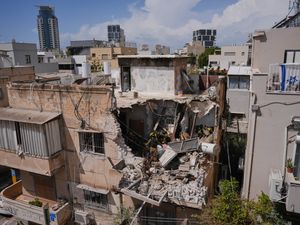
Loud booms were heard in Tel Aviv, where cluster bomblets hit several places earlier on Sunday.

Kuwait and the United Arab Emirates (UAE) said their air defences were dealing with missile and drone attacks from Iran early on Monday, while air raid sirens sounded in Bahrain.
An Indian national living in the UAE was hurt by falling shrapnel after the interception of a ballistic missile over an industrial area near Al Dhafra Air Base in Abu Dhabi, authorities said on Monday.
In Saudi Arabia, the Defence Ministry said it destroyed drones in the kingdom’s oil-rich Eastern Province.
Iranian foreign minister Abbas Araghchi said on Sunday that maritime traffic is not passing through the Strait of Hormuz because insurance companies are concerned about the US-initiated war, not because of Iran’s actions.
“Freedom of Navigation cannot exist without Freedom of Trade. Respect both—or expect neither,” Mr Araghchi wrote on X. He added that further threats will not sway Iranians nor insurers.
Mr Araghchi wrote to the UN Security Council, urging them to “compel the aggressors to immediately cease all unlawful attacks” and make them pay reparations for damage to Iran’s nuclear and other sites. Iran’s main enrichment site, Natanz, was struck again on Saturday.

Iran insisted ‘safe passage’ in the Strait of Hormuz is possible for non-enemies. A Foreign Ministry statement said “vessels, equipment and any capacities” belonging to the US and Israel, “as well as other participants in the aggression,” do not qualify.
It also said any security arrangements in the Persian Gulf, Strait of Hormuz and Sea of Oman must be coordinated with Iran’s “competent authorities,” while taking into account “realities” around armed conflict.
An Israeli strike in the Gaza Strip hit a vehicle in the central Nuseirat refugee camp and killed three police officers, according to officials with Awda Hospital.
Eight others were wounded, the officials said, and another Palestinian was killed in Gaza City, according to Shifa hospital.
Israeli leaders visited one of two southern communities near a secretive nuclear research site struck by Iranian missiles late on Saturday, with scores of people wounded. Prime Minister Benjamin Netanyahu said it was a “miracle” that no one was killed.
Mr Netanyahu claimed Israel and the US were well on their way to achieving their war goals. The aims have ranged from weakening Iran’s nuclear programme, missile programme and support for armed proxies to enabling the Iranian people to overthrow the theocracy.
The death toll from the war has risen to more than 1,500 people in Iran, more than 1,000 people in Lebanon, 15 in Israel and 13 US military members, as well as a number of civilians on land and sea in the Gulf region. Millions of people in Lebanon and Iran have been displaced.