Israel launches strikes on Beirut after Hezbollah fires missiles across border
The strikes follow the US and Israel pounding targets across Iran on Sunday as part of an intensifying military campaign.
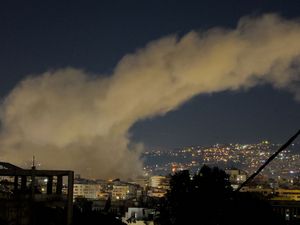
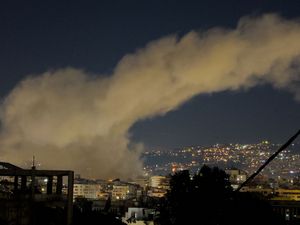
Israel launched strikes on Lebanon’s capital Beirut after the militant group Hezbollah fired missiles across the border early on Monday.
The strikes follow the US and Israel pounding targets across Iran on Sunday as part of an intensifying military campaign which followed the killing of Supreme Leader Ayatollah Ali Khamenei.
It was the first time in more than a year that Hezbollah claimed a strike against Israel, saying in a statement that the strikes were carried out in retaliation for the killing of Mr Khamenei and for “repeated Israeli aggressions”.
The Israeli military said it intercepted a projectile that crossed the border and that several others fell in open areas. No injuries or damage were reported.
Lebanese government officials had urged Hezbollah not to enter the fray in support of Iran, fearing another war.
The Israeli military urged people in nearly 50 villages in Lebanon to evacuate ahead of possible retaliatory strikes.
Iraqi Shiite militia group Saraya Awliya al-Dam claimed a drone attack on Monday targeting US troops at the airport in Iraq’s capital, Baghdad.
Iran’s retaliatory strikes went beyond US and Israeli targets, pushing the conflict into cities that have long marketed themselves as regional safe havens.
The foreign ministers of Qatar, Saudi Arabia, the United Arab Emirates, Kuwait, Oman and Bahrain said on Sunday that their countries retain “the legal right to respond and the right to self-defence” after Iranian strikes hit hotels, airports and other sites in multiple cities throughout the Gulf.
In the United Arab Emirates, authorities said most Iranian missiles and drones were intercepted. But some either got through or fell as debris, killing three people, injuring others and causing significant damage.
Bahrain and Kuwait said Iranian strikes in both countries hit civilian targets. Bahrain said on Monday that one person was killed by shrapnel from an intercepted missile.
Iran’s foreign minister suggested his country’s military units are acting independently from any central government control after being pressed about attacks on Gulf Arab nations
In an Al Jazeera interview on Sunday, Abbas Araghchi said: “What happened in Oman was not our choice. We have already told our, you know, army, armed forces to be careful about the targets that they choose.
“As a matter of fact, our, you know, military units are now in fact independent and somehow isolated and they are acting based on instructions — you know, general instructions — given to them in advance.”
The attacks on Iran have sent a chill through world markets. Shares opened sharply lower in Tokyo and Australia early on Monday and oil prices soared.
Attacks throughout the region, including on two vessels transiting the Strait of Hormuz, the narrow mouth of the Persian Gulf, disrupt the region’s ability to export oil.
A barrel of Brent crude oil, the international standard, was trading at around 79 dollars (£59) per barrel Sunday night, according to FactSet, up about 8% from Friday.

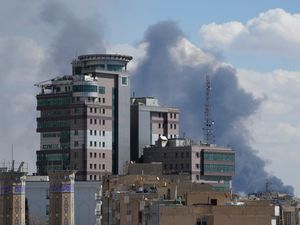
More than 200 people have been killed since the start of the strikes that killed Mr Khamenei and other senior leaders, Iranian leaders have said, as blasts across the country rattled windows and sent plumes of smoke high into the sky above the capital city of Tehran.
The US military said Iranian missiles resulted in the deaths of three service members — the first known American casualties from the conflict.
Israel’s rescue services said nine people were killed and 28 wounded in a strike that hit a synagogue in the central town of Beit Shemesh, bringing the overall death toll in the country to 11. Eleven people were still missing after the strike, police said.
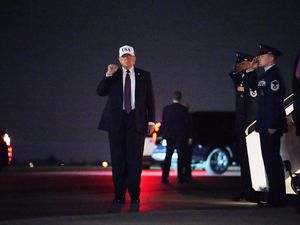
Speaking in a video message, US President Donald Trump said America would “avenge” the deaths of the service members and that “there will likely be more” killed before the conflict ends.
The president made the comments in a roughly six-minute video he posted on social media on Sunday afternoon.
He called the three service members “true American patriots who have made the ultimate sacrifice for our nation, even as we continue the righteous mission for which they gave their lives”.
He added: “Sadly, there will likely be more, before it ends. That’s the way it is. Likely be more.”
Mr Trump said on social media that nine Iranian warships had been sunk and that the Iranian navy’s headquarters had been “largely destroyed”.
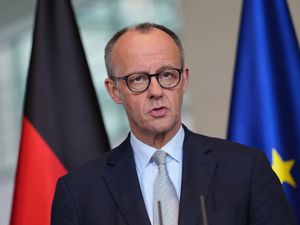
In an indication that the conflict could draw in other nations, Britain, France and Germany said on Sunday that they were ready to work with the US to help stop Iran’s attacks.
Leaders of the countries said in a joint statement that they were “appalled” by Iran’s “reckless” strikes on their allies.
Mr Trump, who a day earlier had encouraged Iranians to “take over” their government, signalled on Sunday that he was open to dialogue with Iran’s new leadership.
“They want to talk, and I have agreed to talk, so I will be talking to them,” he told The Atlantic.

In Tehran, there was little sign that Iranians had heeded Mr Trump’s call for an uprising against the government.
The streets were largely deserted as people sheltered during heavy airstrikes, witnesses told The Associated Press (AP), speaking anonymously for fear of retribution.
The paramilitary Basij, which has played a central role in crushing protests, had set up checkpoints across the city, they said.
Iranian President Masoud Pezeshkian said in a pre-recorded message that a new leadership council had begun its work.
The country’s foreign minister, Abbas Araghchi, said a new supreme leader would be chosen in “one or two days”.
A senior White House official who spoke on condition of anonymity, said Mr Trump was eventually willing to talk but that the operation would continue unabated for now.