Iran’s president says attacks inflicted ‘grievous blow’ on global trust
Masoud Pezeshkian’s comments at the UN General Assembly are the first time he has spoken in a global forum since the summer’s 12-day Israel-Iran war.
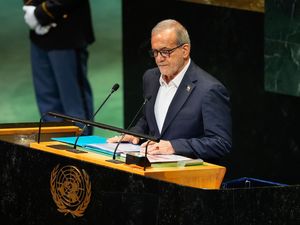
Addressing the world’s leaders, Iranian President Masoud Pezeshkian blamed the US and Israeli attacks for “dealing a grievous blow” to peace negotiations as Tehran braces for the reinstatement of sanctions in the next week, barring a last-minute diplomatic breakthrough.
Hours before his speech, Iran’s rial currency fell to a new all-time low.
Mr Pezeshkian’s remarks before the UN General Assembly are the first in a global forum since the 12-day Israel-Iran war over the summer that saw the assassination of many of the Islamic Republic’s highest military and political leaders and broke down weeks of negotiations with the United States.
“Ladies and gentlemen, you all bore witness that this past June, my country was subjected to a savage aggression and flagrant contravention of the most elementary principles of international law,” said the president, who within Iran’s political landscape is considered a moderate politician.
Mr Pezeshkian is in New York as Tehran seeks to engage in last-minute talks with European nations to stop the coming reimposition of UN sanctions on Iran over its nuclear programme.
But before even landing in the US, any diplomatic efforts planned by Mr Pezeshkian and Iran’s foreign minister Abbas Araghchi were overshadowed when Supreme Leader Ayatollah Ali Khamenei rejected any direct nuclear talks with America in a speech on Tuesday.
“The US has announced the results of the talks in advance,” he said.
“The result is the closure of nuclear activities and enrichment. This is not a negotiation. It is a diktat, an imposition.”
France, Germany and the United Kingdom triggered the so-called “snapback mechanism” to reinstate sanctions – barring a last-minute accord – over Iran’s failure to comply with conditions of a 2015 nuclear deal aimed at preventing Tehran from developing nuclear weapons.
“Snapback” was designed to be veto-proof at the UN.
It started a 30-day window for the resumption of sanctions, which ends on Sunday, unless the West and Iran reach a diplomatic agreement.
European nations have said that they would be willing to extend the deadline if Iran resumes direct negotiations with the US over its nuclear programme, allows UN nuclear inspectors access to its nuclear sites and accounts for the more than 400 kilograms of highly enriched uranium that the UN watchdog says it has.
Iran is the only nation in the world that enriches uranium up to 60% – a short, technical step away from weapons-grade levels – that does not have a weapons programme.
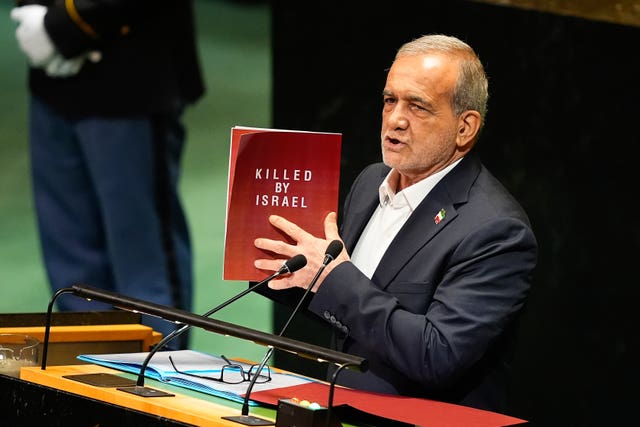
But Mr Pezeshkian used his UN speech to criticise the E3 for having operated in “bad faith” for years to dictate Iranian compliance with a deal that the US abandoned in 2018.
“They falsely presented themselves as parties of good standing to the agreement, and they disparaged Iran’s sincere efforts as insufficient,” he said.
If no diplomatic deal is found this week, the sanctions will automatically “snapback” on Sunday.
That would again freeze Iranian assets abroad, halt arms deals with Tehran and penalise any development of Iran’s ballistic missile programme, among other measures, further squeezing the country’s reeling economy.
Earlier this month, the UN nuclear watchdog and Iran signed an agreement mediated by Egypt to pave the way for resuming co-operation, including on ways of relaunching inspections of Iran’s nuclear facilities.
However, that agreement has yet to fully take hold.
In July, Mr Pezeshkian had signed a law adopted by his country’s parliament suspending all co-operation with the International Atomic Energy Agency (IAEA).
That followed Israel’s 12-day war with Iran in June, during which Israel and the US bombed Iranian nuclear sites.
Iran has long insisted its programme is peaceful, though Western nations and the Vienna-based IAEA assess that Tehran had an active nuclear weapons programme until 2003.
Khamenei again said on Tuesday that Iran does not seek atomic bombs.
However, he added: “Science will not be demolished by threats and bombing.”