Kremlin calls minister’s death ‘tragic’ but gives no clues on apparent suicide
Roman Starovoit, who served in his post as transport minister for a little over a year, was found dead from a gunshot wound.
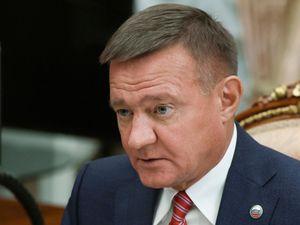
The apparent suicide of Russia’s transportation minister brought expressions of shock and sorrow from the Kremlin but no new clues as to why Roman Starovoit might have taken his own life.
It comes amid media speculation that he was potentially facing corruption charges.
Mr Starovoit, who served in his post for a little over a year, was found dead from a gunshot wound – news that broke hours after a decree was issued on Monday by Russian President Vladimir Putin that dismissed the 53-year-old cabinet member.
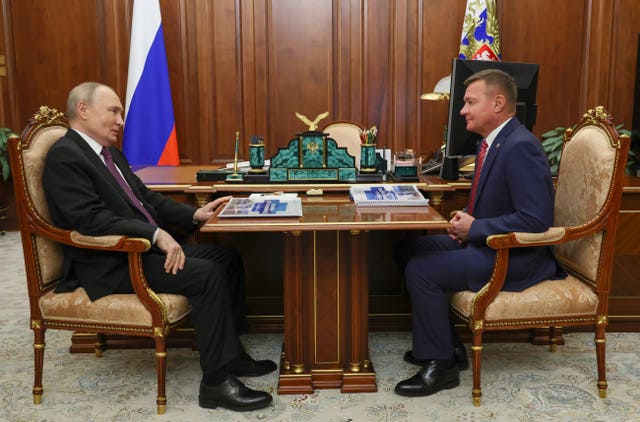
Mr Starovoit’s body was found in the Odintsovo district just west of the capital that is home to many members of Russia’s elite, according to the Investigative Committee, the country’s top criminal investigation agency.
It said that a criminal probe was launched into his death and investigators saw suicide as the most likely cause.
The agency said Mr Starovoit’s body was found in his car, but Russian media that carried images from the scene later reported that he was found dead in a small park next to a parking lot where he left his Tesla and a pistol presented to him as an official gift was at his side.
The reports said Mr Starovoit’s personal assistant was asked to identify his body and she was seen weeping afterwards.
Kremlin spokesman Dmitry Peskov refused to comment on the circumstances of Mr Starovoit’s death, saying that investigators will have to determine the details.
“Such information is always tragic and sad,” Mr Peskov said, noting that Mr Putin was immediately informed about it.
“Naturally, we were shocked by it.”
Russian media reported that Mr Starovoit’s dismissal and his death could have been linked to an investigation into the embezzlement of state funds allocated for building fortifications in the Kursk region, where he was governor for five years before becoming transportation minister.
Mr Starovoit’s successor as governor, Alexei Smirnov, stepped down in December and was arrested on embezzlement charges in April.
Some Russian media have claimed that Mr Smirnov had told investigators about Mr Starovoit’s alleged involvement in the corruption scheme and his arrest appeared inevitable.
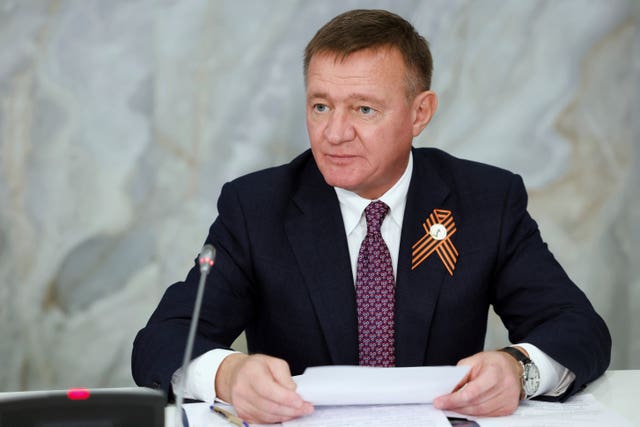
Some commentators even alleged that Mr Starovoit’s associates in higher echelons could have ordered his killing to avoid exposure.
The alleged embezzlement has been cited as one reason behind the Russian military’s failure to stem a surprise August 2024 incursion in the region by Ukrainian troops that quickly overwhelmed lightly armed Russian border guards and inexperienced army conscripts.
The incursion humiliated the Kremlin — the first time the country’s territory was occupied by an invader since the Second World War.
The Russian military announced in April that its troops had fully reclaimed the border territory nearly nine months after losing chunks of the region.
Ukraine had disputed that assertion.
On July 1, former deputy defence minister Timur Ivanov was convicted on charges of embezzlement and money laundering and sentenced to 13 years in prison in a high-profile case that exposed rampant military corruption widely blamed for Moscow’s military setbacks in Ukraine.
Mr Ivanov was the most visible figure in a far-ranging probe into alleged military graft that also targeted several other top officials who were close to former defence minister Sergei Shoigu.
Mr Shoigu, a veteran official who had personal ties to Mr Putin, survived the purge of his inner circle and was given a high-profile post of secretary of Russia’s Security Council.
Mr Ivanov, 49, was named deputy defence minister in 2016 and oversaw military construction projects, as well as property management, housing and medical support for the troops.
He was known for his lavish lifestyle that outraged many in Moscow just as the fighting in Ukraine exposed glaring deficiencies in Russian military organisation and supplies that resulted in battlefield setbacks.
Mr Putin named Andrei Nikitin, who served as deputy transport minister, to replace Mr Starovoit.
Legislators in the lower house of Russian parliament quickly endorsed his appointment on Tuesday.
Mr Starovoit, who was divorced, is survived by two teenage daughters.