Senate begins voting as Republicans search for support for Trump’s big bill
Senate majority leader John Thune spent the night searching for last-minute agreements.
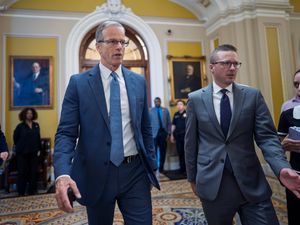
The US Senate has started voting on Donald Trump’s big bill of tax breaks and spending cuts after a turbulent overnight session.
Republican leaders announced they believe they have overcome dissent from their own ranks and secured enough support to power past Democratic opposition.
Senate majority leader John Thune spent the night searching for last-minute agreements between those in his party worried that the bill’s reductions to Medicaid will leave millions without care, and his most conservative flank, which wants steeper cuts to hold down deficits ballooning with the tax cuts.
Vice president JD Vance was at the Capitol, on hand to break a tie vote if needed.

It is a pivotal moment for the Republicans, who have control of Congress and are racing to wrap up work with just days to go before the president’s deadline on Friday.
The 940-page One Big Beautiful Bill Act, as it is formally titled, has consumed Congress as its shared priority with the president.
House speaker Mike Johnson has signalled more potential problems ahead, warning that the Senate package could run into trouble when it is sent back to the House for a final round of voting, as sceptical legislators are being called back to Washington ahead of Mr Trump’s July 4 deadline.
The president acknowledged it is “very complicated stuff”, as he left the White House On Tuesday.
“We’re going to have to see the final version,” he said. “I don’t want to go too crazy with cuts. I don’t like cuts.”

What started as a routine but laborious day of amendment voting spiralled into an almost round-the-clock marathon as Republican leaders were buying time to shore up support. It was among the longest sessions processing the most amendments in modern times.
The droning roll calls in the chamber belied the frenzied action to steady the bill. Grim-faced scenes played out on and off the Senate floor, and tempers flared.
The Republican leaders have no room to spare, with narrow majorities in both chambers. Mr Thune can lose no more than three Republican senators, and already two — Thom Tillis and Rand Paul — have indicated opposition.
Attention quickly turned to key senators Lisa Murkowski and Susan Collins, who have worked to stem the health care cuts, as well as a loose coalition of four conservative senators pushing for even steeper reductions.
And on social media, billionaire Elon Musk again lashed out at Republicans as “the PORKY PIG PARTY!!” for including the 5 trillion dollar (£3.6 trillion) debt limit provision, which is needed to allow continued borrowing to pay the bills.
Senate Democratic leader Chuck Schumer said: “Republicans are in shambles because they know the bill is so unpopular.”
The bill includes 4.5 trillion dollars (£3.2 trillion) in tax cuts, according to the latest analysis, making permanent Mr Trump’s 2017 rates, which would expire at the end of the year if Congress fails to act, while adding the new ones he campaigned on, including no taxes on tips.
The package would roll back billions of dollars in green energy tax credits, which Democrats warn will wipe out wind and solar investments nationwide.
It would impose 1.2 trillion dollars (£870 billion) in cuts, largely to Medicaid and food stamps, by imposing work requirements on able-bodied people, including some parents and older Americans, making sign-up eligibility more stringent and changing federal reimbursements to states.
Additionally, the bill would provide a 350 billion dollar (£254 billion) infusion for border and national security, including for deportations, some of it paid for with new fees charged to immigrants.