Israeli strikes damage Iran’s underground nuclear site, agency says
Iran has retaliated by launching more than 370 missiles and hundreds of drones at Israel.
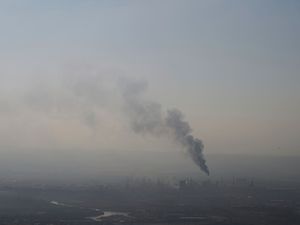
The International Atomic Energy Agency (IAEA) said it believes Israeli air strikes on Iran’s Natanz enrichment site have had “direct impacts” on the facility’s underground centrifuge halls.
The strikes are part of an air campaign Israel launched against its long-time enemy five days ago, targeting Iran’s military and nuclear programme.
This marks the first time the UN’s nuclear watchdog has assessed damage from the strikes in the underground parts of Natanz, which is the main enrichment facility of Iran’s nuclear programme.
“Based on continued analysis of high-resolution satellite imagery collected after Friday’s attacks, the IAEA has identified additional elements that indicate direct impacts on the underground enrichment halls at Natanz,” the agency said.
Already, an above-ground enrichment hall had been destroyed, as well as electrical equipment that powered the facility.
Israel continued to pound Iran on Tuesday, while US President Donald Trump posted an ominous message warning Tehran residents to evacuate.
“Iran can not have a nuclear weapon,” Mr Trump wrote on Monday night before returning to Washington early from a G7 summit in Canada.
“Everyone should immediately evacuate Tehran!” he added.
Mr Trump later denied he had rushed back to work on a ceasefire, telling reporters on Air Force One during the flight back to Washington: “I’m not looking at a ceasefire. We’re looking at better than a ceasefire.”
Asked why he had urged for the evacuation of Tehran, he said: “I just want people to be safe.”
Earlier, the Israeli military had called for some 330,000 residents of a neighbourhood in downtown Tehran to evacuate.
Tehran is one of the largest cities in the Middle East, with around 10 million people, roughly equivalent to the entire population of Israel. People have been fleeing since the hostilities began.
Israel says its sweeping assault on Iran’s top military leaders, nuclear scientists, uranium enrichment sites and ballistic missile programme is necessary to prevent its long-time adversary from getting any closer to building an atomic weapon.
The strikes have killed at least 224 people in Iran and wounded 1,277 since Friday.
Iran has retaliated by launching more than 370 missiles and hundreds of drones at Israel.
So far, 24 people have been killed in Israel and more than 500 wounded. The Israeli military said a new barrage of missiles was launched on Tuesday, and explosions could be heard in northern Israel.

Downtown Tehran appeared to be emptying out early Tuesday, with many shops closed. The ancient Grand Bazaar was also closed, something that only happened in the past during anti-government demonstrations or at the height of the coronavirus pandemic.
On the roads out of Tehran to the west, traffic stood bumper to bumper. Many appeared to be heading to the Caspian Sea area. Long lines also could be seen at petrol stations in Tehran, with printed placards and boards calling for a “severe” response to Israel visible across the city.
Authorities cancelled leave for doctors and nurses as the attacks continue, but insisted everything was under control and did not offer any guidance for the public on what to do.
The Israeli military meanwhile claimed to have killed someone it described as Iran’s top general in a strike on Tehran. Iran did not immediately comment on the reported killing of Gen Ali Shadmani, who had just been named as the head of the Khatam al-Anbiya Central Headquarters, part of the paramilitary Revolutionary Guard.
Iran has named other generals to replace the top leaders of the guard and the regular armed forces after they were killed in earlier strikes.
Before leaving the summit in Canada, Mr Trump joined the other leaders in a joint statement saying Iran “can never have a nuclear weapon” and calling for a “de-escalation of hostilities in the Middle East, including a ceasefire in Gaza”.
French President Emmanuel Macron told reporters that discussions were under way on a ceasefire between Israel and Iran, but Mr Trump appeared to shoot that down in his comments on social media.
Mr Macron “mistakenly said that I left the G7 Summit, in Canada, to go back to D.C. to work on a ‘cease fire’ between Israel and Iran,” Mr Trump wrote. “Wrong! He has no idea why I am now on my way to Washington, but it certainly has nothing to do with a Cease Fire. Much bigger than that.”

Meanwhile, US defence secretary Pete Hegseth headed to the White House situation room to meet the president and his national security team.
Mr Hegseth did not provide details on what prompted the meeting but said on Fox News late Monday that the movements were to “ensure that our people are safe”.
Mr Trump said he was not ready to give up on diplomatic talks, and could send vice president JD Vance and special envoy Steve Witkoff to meet the Iranians.
“I may,” he said. “It depends on what happens when I get back.”
Israeli military spokesperson Brig Gen Effie Defrin said on Monday his country’s forces had “achieved full aerial superiority over Tehran’s skies”.
The military said it destroyed more than 120 surface-to-surface missile launchers in central Iran, a third of Iran’s total, including multiple launchers just before they launched ballistic missiles towards Israel. It also destroyed two F-14 fighter planes that Iran used to target Israeli aircraft, the military said.
Israeli military officials also said fighter jets had struck 10 command centres in Tehran belonging to Iran’s Quds Force, an elite arm of its paramilitary Revolutionary Guard that conducts military and intelligence operations outside Iran.
Israel’s military issued an evacuation warning for a part of central Tehran that houses state TV and police headquarters, as well as three large hospitals, including one owned by the guard. It has issued similar evacuation warnings for parts of the Gaza Strip and Lebanon ahead of strikes.
On Monday, an Israeli strike hit the headquarters of Iran’s state-run TV station, sending a television anchor fleeing her studio during a live broadcast. The Israeli military said on Tuesday it had hit the station because “the broadcast channel was used to spread anti-Israel propaganda”.
Prime Minister Benjamin Netanyahu said the Israeli strikes have set Iran’s nuclear programme back a “very, very long time”, and told reporters he is in daily contact with Mr Trump.
Iran maintains its nuclear programme is peaceful.