
How local students can balance school, homework, and free time


How to find a health way to balance school, homework and aids to study
Students today face an increasingly complex daily schedule. Between school hours, homework responsibilities, extracurricular activities, social life, and personal interests, it can feel nearly impossible to maintain a healthy balance. Without a strategic approach, academic pressure quickly expands into evenings and weekends, leaving little room for relaxation or personal growth. By developing structured routines and setting boundaries between study and leisure, you can create a lifestyle that supports both academic excellence and mental well-being.
Creating a structured daily schedule
To balance school and homework schedules, you need to start with a predictable daily routine. Planning your day in advance allows you to remove uncertainty and reduce the stress of unfinished work. It’s similar to the situations when you know how to manage homework assignments and apply the most effective sequence of actions. For instance, instead of staring at a blank page, you can use an essay generator to help you understand what good essay structure and layout looks like, and to inspire your own productivity and ideas. Try structuring the day into three primary blocks:
● School hours
● Homework and study time
● Personal free time
A typical balanced weekday planned according to student time management rules might follow this structure:
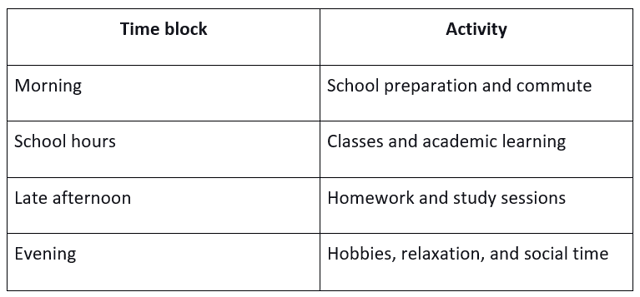
Consistency trains the brain to expect focused work at certain times and relaxation at others. Over time, productivity increases while study fatigue decreases.
Prioritising homework without overworking
Students often feel overwhelmed by homework because they approach assignments randomly. Instead, we recommend using priority-based homework time management.
At the start of each study session, students should list all assignments and categorize them by:
1. Urgency – assignments due soon
2. Difficulty – tasks requiring more concentration
3. Importance – work that significantly impacts grades
Begin with high-priority or challenging tasks while energy levels are highest. Easier tasks can be completed later when concentration naturally declines. This structured approach prevents procrastination and ensures that important academic work receives the attention it deserves.
Setting effective homework time limits
Many students mistakenly believe that more hours automatically lead to better grades. In reality, long study sessions reduce concentration and productivity.
Use focused time blocks, such as:
● 25–30 minutes of concentrated work
● 5-minute short breaks
● A longer break after several study cycles
This method keeps the mind fresh while maintaining consistent progress. Instead of spending four exhausting hours studying, students often complete the same work in two highly focused hours. Short breaks also help prevent burnout and maintain motivation throughout the day.
Protecting free time for mental and emotional health
Free time is not wasted time. It is a necessary component of healthy learning and cognitive performance. When students schedule regular periods for rest and enjoyment, they return to academic tasks with renewed focus.
Protect time for:
● Physical activities or sports
● Creative hobbies
● Reading for pleasure
● Social interaction with friends
● Relaxation and digital downtime
Balanced leisure activities support emotional stability and reduce stress. Students who maintain consistent recreation time often perform better academically because their minds remain energized and engaged.
Limiting distractions during study hours
Distractions are one of the most significant barriers to efficient homework completion. Phones, social media, television, and online messaging can turn a 30-minute assignment into a two-hour struggle.
Make sure to establish a dedicated study environment that minimizes interruptions. Effective study conditions include:
● A quiet workspace
● A clean and organized desk
● Turning phones to silent or placing them outside the room
● Using website blockers during homework time
By removing unnecessary distractions, students dramatically improve focus, efficiency, and learning retention.
Balancing extracurricular activities
Extracurricular activities enrich the student experience and build valuable life skills. However, overscheduling can create stress and reduce time available for homework and rest.
Select a limited number of meaningful activities rather than attempting to participate in everything available.
Ideal extracurricular choices include:
● Sports teams for physical health
● Creative arts such as music, theatre, or painting
● Academic clubs and competitions
● Volunteer and community service programs
When chosen carefully, extracurricular activities enhance discipline, teamwork, and leadership while still allowing students to maintain healthy academic routines.
A balanced student life is achievable
When students take control of their schedules, they discover that academic success does not require sacrificing personal happiness. With structured routines and protected leisure time, you can create a lifestyle that supports both high academic performance and meaningful personal experiences.
Apply these principles to develop confidence, resilience, and the ability to thrive both inside and outside the classroom.