UK renewables auction brings 8.4GW of offshore wind power
The auction marks a record for offshore wind capacity as the Government looks to decarbonise the UK’s grid by 2030.
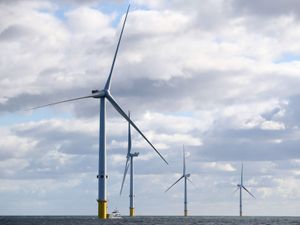
The Government has secured a record 8.4 gigawatts (GW) of offshore wind power in its flagship auction for green energy schemes.
The latest round of contracts comprises six new projects located off the coast in different areas of the country.
While last year hit a record number of projects at nine, this year marks a record in the capacity of power bought.
The projects include Berwick Bank in the North Sea – the first new Scottish project since 2022, and the largest planned offshore wind project in the world.
Two others are at Dogger Bank South, off the coast of Yorkshire, and Norfolk Vanguard, off the East Anglian coast – two of the largest offshore wind farms in the world.
Awel Y Mor in the Irish Sea is the first Welsh project to win a contract in more than a decade.
The auction round is also supporting UK efforts to develop floating offshore wind technologies, which see turbines mounted on floating platforms rather than fixed foundations.
The new contracts include two such projects: Erebus, off the Pembrokeshire coast in the Celtic Sea, and Pentland, off the coast of Dounreay in Scotland, which are backed by investment from Great British Energy and the National Wealth Fund.
The Department for Energy Security and Net Zero said the new projects would generate enough electricity to power 12 million homes, deliver around £22 billion in private investment, support 7,000 jobs and help the UK tackle the climate crisis.
The price for offshore wind was agreed at 40% lower than the cost of building and operating a new gas power plant, according to a key industry metric.
Energy Secretary Ed Miliband said: “With these results, Britain is taking back control of our energy sovereignty.
“This is a historic win for those who want Britain to stand on our own two feet, controlling our own energy rather than depending on markets controlled by petrostates and dictators.”
Experts had said he would need to commission 8.4GW of new offshore wind capacity during the auction round to stay on track to meet the Government’s target of removing almost all fossil fuels from the UK’s electricity supply by 2030.
Matching this figure on Wednesday, Mr Miliband said the auction marked a “monumental step” towards Labour’s wider goal.
Because renewable projects can be expensive, developers bid to secure a guaranteed rate – or a strike price – they can charge for each megawatt hour (MWh) of power they generate in the coming years.
If the price of electricity on the open market dips below that, subsidies will top up payments to companies. If the price is higher, companies have to pay back the difference.
The Government has secured a strike price of £91 per MWh on average or just over £65 in the commonly used benchmark of 2012 prices.
In contrast, the Levelised Cost of Energy (LCOE) industry metric on Wednesday showed the cost of building and operating a new gas-fired power station at £147 per megawatt hour.
Mr Miliband wrote on X that the 40% lower strike price has disproved claims by right-wing detractors of clean power.
“Clean, homegrown power is the right choice to bring down bills for good, and this auction will create thousands of jobs throughout Britain,” he said.
Since the auctions started in 2015, offshore wind has boomed, with the price of developing projects falling and output soaring.
In 2015’s auction, 1GW of offshore wind contracts were agreed. By the fourth round in 2022 it was 7GW.
Over that period, the strike price dropped by almost 70% thanks to market confidence generated by government help and economies of scale.
The fifth round in 2023 saw no new offshore wind development contracts agreed after no companies submitted bids because the strike price was too low.
This marked a setback for the previous government, which had committed to having 50GW of offshore wind by 2050.
Previous auctions had announced secured capacity for various renewable technologies – including offshore and onshore wind, solar and tidal – but this year the process has been split up with only the results for offshore wind announced on Wednesday.
The Government secured a record 11GW of winning bids for various technologies in the 2022 auction, and 9.6GW last year.