
Market Drayton educator collects ‘Nobel’ of early education
The award has been described as ‘the Nobels of Early Education’
An educator from Market Drayton is on her way home from Munich having collected a prestigious Habermaass Prize, described as ‘the Nobels of Early Education.’
Earlier this week, on behalf of the Early Years Coalition, Market Drayton educator Nancy Stewart accepted the 2026 Habermaass Stiftung Prize for an outstanding collaborative achievement in advancing the quality, professionalism and sustainability of early years education.
Five years ago, Nancy led a ground-breaking collaboration involving 100 Early Years experts which produced the curriculum guidance Birth to 5 Matters. It has since been downloaded over 400,000 times, across dozens of countries as well as the UK.
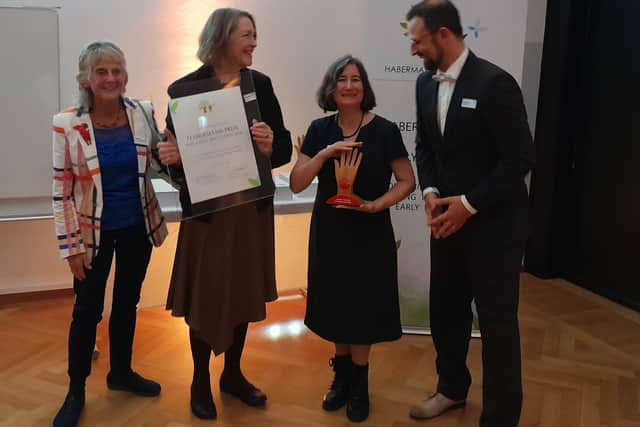

Nancy’s latest project has been to lead the revision and updating of this influential guidance. This work has now been recognised with an inaugural Habermaass Prize, the only international award which honours contributions that have a lasting impact on the understanding, quality, and future-readiness of early education.
Her career began in the classroom, teaching and leading the Foundation Stage at Ellesmere Primary School. She went on to become an Early Years Consultant for Shropshire County Council, advising primary schools and early years settings in Market Drayton and across north Shropshire.
She later became a Senior Early Years Advisor for the government, contributing to a number of key national developments. Her book, ‘How Children Learn: The Characteristics of Effective Early Learning’, further established her reputation as a leading voice in early education.
Reflecting on the award, Nancy said: “Leading the Birth to 5 project has been a tremendous privilege. Through multiple large-scale surveys, we sought the views of practitioners, managers, trainers and researchers. More than 20 expert groups developed draft sections, which were then shared for further detailed consultation.
“What we achieved was truly ‘guidance by the sector, for the sector’. It is this powerful collaborative process, as well as the content itself, that has been recognised by the Habermaass judges.”