
Shropshire mining tragedy which plunged a town into mourning

Victim of Dawley pit disaster had warned something was wrong on the eve of the accident
The evening before he died, young Shropshire miner John Yale told his dad about his worries about the safety of the pit chain.
James Yale told his son to go to the pit no more, and said he would stand by him if he was summonsed for neglect of work.
But John went to work at the Springwell Pit at Little Dawley as usual. As he and others were being lifted back to the surface after their shift, the chain broke, sending them plunging to their deaths.
Seven died at once. An eighth man, 19-year-old John Davies, was brought to the surface alive but horribly maimed and quickly expired.
It happened on Friday, December 6, 1872, and was one of Shropshire's worst mining disasters. And it was a double blow for Dawley. Less than a month earlier five miners from the area had been among 22 who died in a disaster at Pelsall Hall Colliery, near Walsall.
As news spread, a large crowd of around 1,000 people gathered at the pithead. But it was quickly clear there was nothing to be done.
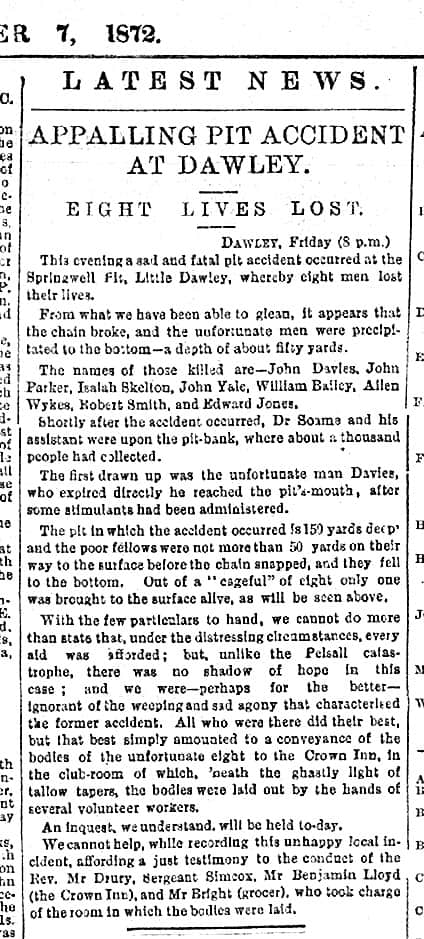
The Shrewsbury Chronicle reported: "There was an entire absence of those distressing scenes which accompany accidents occurring in larger mining districts. There were no weeping wives or children, for the whole of the men killed were unmarried, with the exception of the man Betley [sic - his name was actually Bailey], who, at the early age of 21, leaves a widow and an orphan."
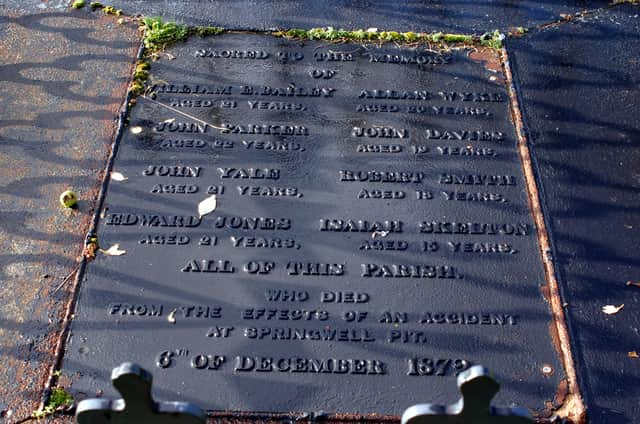
The victims were: John Davies, 19, filler, of Brandlee; Edward Jones, 21, miner, Stocking; Isaiah Skelton, 15, miner, Little Dawley; Allan Wyke, 20, miner, Finney; Robert Smith, 18, miner, Holly Hedge; William Bailey, 21, miner, and the only one of the dead to be married, Finney; John Parker, 22, miner, Holly Hedge; and John Yale, 21, miner, Dawley.
It must have been the biggest funeral in Dawley’s history, with up to 10,000 present.
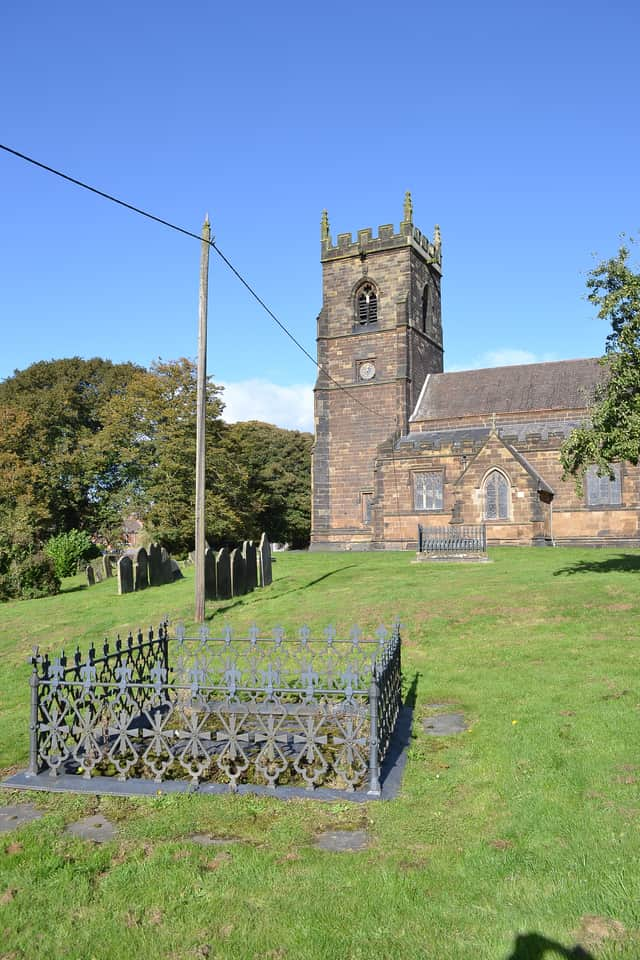
The route of the cortege was crowded, while thousands crammed the graveyard of Dawley Parish Church. All shops in Dawley closed, and the church was overflowing, with hundreds unable to get in.
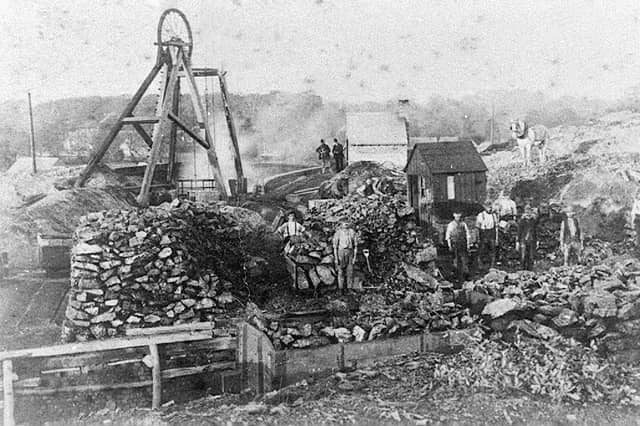
At Springwell Pit, which was operated by the Coalbrookdale Company, the men and boys were brought to the top in what were known as “bandfuls,” that is, they attached themselves by chains, in which they sat, to a link fixed at the end of the shaft chain.
John Yale was not the only victim to have expressed fears about the safety of the chain. Another, John Parker, had raised similar concerns.
Martin Cooper, the Shropshire miners' agent, questioned whether it was true that 18 men had refused to go down the pit because the chain was not considered safe, and whether summonses had been taken out against them for refusing.
However, he produced no evidence in support, and the Coalbrookdale Company's representative, solicitor George Burd, would write to the Wellington Journal categorically denying it.
The inquest, held at the Crown Inn, Little Dawley, was delayed by the fact that links of the broken chain were still missing and so could not be examined.
At the resumption there was a surprise when one of the jurymen, a Mr Rowley, pulled a small parcel from his pocket containing the two missing links, saying they were given to him on the day of the previous hearing by the banksman, named Evans.
There are different versions as to why the banksman had not given them up previously. One was that he was afraid. The other is that he was hoping for a reward.
The inquest jury pointed the finger of blame for the tragedy at Samuel (or William, reports differ) Heighway, the colliery engineer, for not examining the chain properly, and, casting the net of blame more widely, said that the colliery rules were “systematically neglected”.
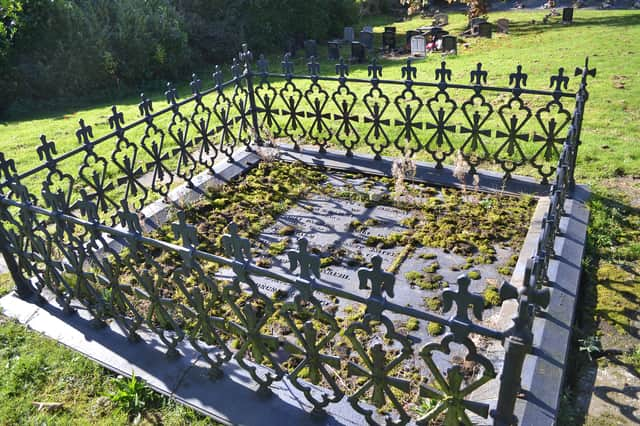
At first enclosed by temporary fencing and ornamented with flowers and evergreens, the victims' communal grave would, the following autumn, become a monument to the disaster through the installation by the Coalbrookdale Company of a substantial tomb plate, with the names and ages of the dead inscribed in gilt lettering, together with massive ornamental railings.
Over the decades its condition deteriorated, but it was restored about 25 years ago, and given a further clean-up in 2019.
Comment Guidelines
Iconic Media encourages reader discussion on our stories. User feedback, insights and back-and-forth exchanges add a rich layer of context to reporting. Please review our Community Guidelines before commenting.