
Work still needed to grow women’s game
This year was finally the year that elite women’s football became entirely professional.
Kicking off in September, the FA Women’s Super League is now composed of 11 professional entities from Brighton & Hove Albion to Manchester City.
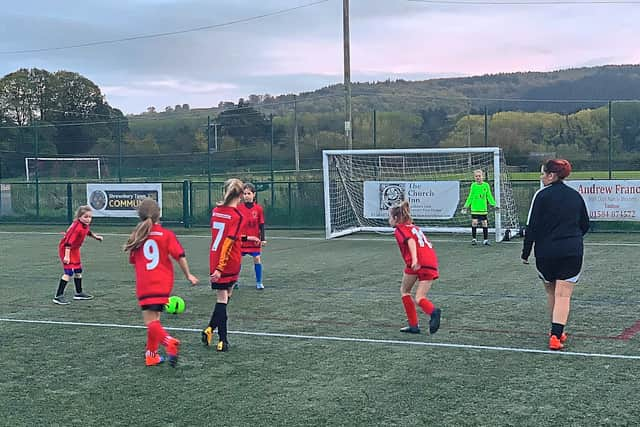

With the national WSL season well under way, what impact will it have on the development of grassroots football in Shropshire?
“More women are taking Sunday League football seriously, with more qualified FA coaches, even at the lowest tier of women’s football,” says Roxy Trow of Ludlow Town Ladies, who has been playing since she was eight.
Former The New Saints defender and current Ludlow Town player Katy Huntbach added: “It will now be seen as more of a career path for women, rather than them having to work alongside it.”
Of course, playing professionally means having the time and resources essential to the development of the women’s game.
Players are able to train full-time, improving fitness and technical skills considerably. Huntbach says that she has also noticed more coverage of the women’s game in the media.
“It’s definitely heading in the right direction,” she said.
However, commitment at local level seems hit and miss.
Trow addds: “We have to fund ourselves, we put on bingo nights to pay for training and match facilities.”
Indeed, the determination of local women to continue playing the game they love is proven by Ludlow Town Ladies.
For years, it has been a case of the team supporting themselves with no sponsor or team photograph, and only with the help of volunteers, such as Kevin Powell.
Equally, Huntbach states that, despite their success in the FA Cup, TNS rarely focused on the development of the women’s team. Huntbach also questions FA rules prohibiting her from playing occasionally for the higher ranking team, TNS, particularly when games are not always regular.
“Going from a lower level to help a higher team for one game should be encouraged” she says, stating that banning the additional pitch time does not promote player development. Nationally, football is the biggest sport played by girls. England are ranked third in the world and have recently qualified for the 2019 World Cup in France.
At the 2017 Euros, the Lionesses comfortably topped their group and were pipped by eventual winners the Netherlands in the semi-finals.
Huntbach believes that with the success of the Lionnesses, and also bigger clubs getting behind the women’s game, it’s helping young girls become inspired.”
“Unfortunately, this is not the case in Ludlow,” says Trow, Ludlow’s only girls football volunteer.
There is currently only an under-12 girls team, coached by Trow, compared with ten years ago when the club sported teams from under-12 to under-16 – all winning leagues and titles.
There is hope that efforts are been made to change this.
Shrewsbury Town in the Community run Girls’ Football Centres across Shropshire, named SSE Wildcats centres, which are a national FA programme for girls aged 5-11 providing girls with regular opportunities to play football and take part in organised sessions in a fun and engaging environment.
Shrewsbury Town in the Community are also a FA licensed Girls Regional Talent Club, a pathway for talented girls into the England Talent Development programme.
In September 2017, STiTC announced that there would be a girls’ football coaching centre in Ludlow for under-10 and upwards, hopefully improving the support volunteers, such as Trow, receive in Ludlow.
Both Trow and Huntbach believe that around Shropshire, girls’ football is getting bigger, and from a younger age.
Eve Bailey, Shropshire FA Girls & Women’s Football Development Officer, said: “It is fantastic to see so many girls teams now playing in the Shropshire Girls & Women’s League for this season.
“However, we are consulting with our current women’s teams in the hope that we can bring back a Women’s County League to Shropshire. We are also working very closely with the Girls League to create a plan to support the transition of youth into adult football.
“We are also excited for the women’s World Cup next year and hopeful the FA will be successful in their bid to host the UEFA Women’s European Championships in 2021.
“These will be exciting times for girls and women’s football and hopefully this will inspire females to continue their journey, try football for the first time, or get back into the game if they have stopped playing.
“We need to help provide those opportunities for players in Shropshire at all levels.”
With the Super League to aspire to, work now goes on to ensure the path to the top is there for girls in Shropshire and around the country.
What do you think? Share your experiences by emailing us at [email protected] and we’ll print the best. Please include your name and address.
Comment Guidelines
Iconic Media encourages reader discussion on our stories. User feedback, insights and back-and-forth exchanges add a rich layer of context to reporting. Please review our Community Guidelines before commenting.