
Shrewsbury Matters: Matron's work immortalised with road sign

It can be a little disconcerting when you're lying there in agony and your doctor seems far more interested in your train set than he is in you.
Although, to be fair, this could have been all part of his bedside manner, keeping the 13-year-old me calm by distracting me with questions about the tiny station master patrolling his tiny station platform.
"Oh, and this is a fine LNER locomotive you have here. Did that come with the original set or did you have to buy that separately?"
What I really wanted to do at this point was let out a scream, but I replied politely (if weakly): "Had to get that separately. But the diesel and the freight trucks came with the original set."
The doctor took another sip of tea from one of our mum's best cups and, after a moment, started asking me about the Triang-Hornby level crossing and the Airfix thatched cottages.
It turned out I had peritonitis and within half an hour I was being lifted onto a stretcher and taken outside and into an ambulance.
In spite of (or perhaps because of) our GP's apparent lack of concern (distraction strategy) back then and also because of the superb care I experienced in hospital, I have had a very high regard for the medical profession ever since.
We're talking about 1970. As I always say, Gilbert O'Sullivan's Nothing Rhymed came out the same time as my appendix.
It was nine years before the opening of the Royal Shrewsbury Hospital and so we're talking about the old Copthorne Hospital and I was in a very long ward with a single television set positioned at the far end.
I was in there for, I think, about six weeks, which now seems like an awfully long time, but I have to say I actually enjoyed my stay.
The other patients were very nice and the nurses were fantastic.
Even back then I thought nurses didn't get the recognition they deserve.
Maybe, I thought to myself . . . maybe nurses should have streets named after them.
And lo and behold, all these years later, on a new housing development near the Royal Shrewsbury Hospital, streets are indeed being named after nurses.
For starters, one street there has been called Cavell Drive after Norfolk-born Edith Cavell.
She helped some 200 Allied soldiers escape from German-occupied Belgium during the First World War.
And then there's Seacole Way after Mary Seacole, honoured for her nursing efforts during the Crimean War.
Okay, these are clearly not nurses who had anything to do with Copthorne Hospital in the 1970s, but, hey, it's a start.
Closer to home, however, another new road on the estate which is currently being built opposite the entrance to the hospital has been named after a former hospital matron who is from the town.
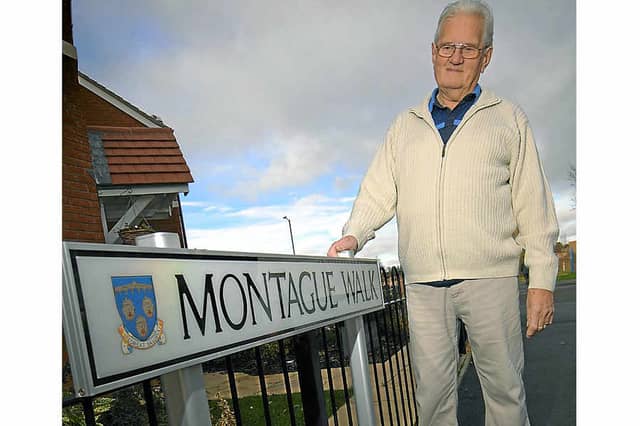
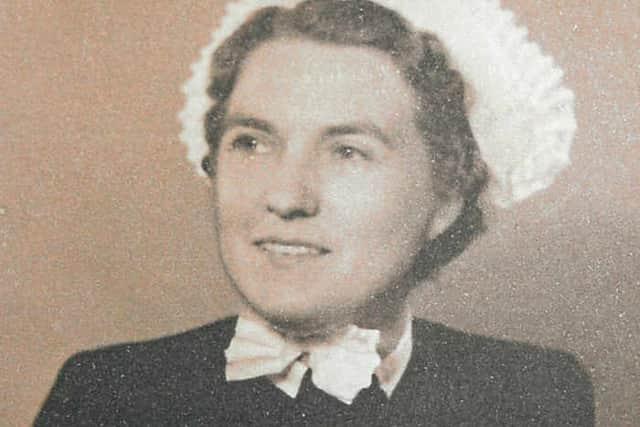
The late Gertrude Montague, who died at the age of 87 in June 2005, has been immortalised through the naming of the new road opposite the RSH.
The shiny new road signs at Montague Walk were erected last month at the new housing estate with the name chosen by her former colleague Brian Bennett, from Hanwood.
Mr Bennett, who held a number of posts in healthcare in Shropshire, chose Miss Montague for the honour in recognition of her work in helping countless numbers of people during her years in nursing.
She was appointed as matron to the Group Training School at the Royal Salop Infirmary, Shrewsbury, in 1952, and held that role until 1972, when her job title was changed to principal nursing officer.
She received the Queen's Silver Jubilee medal in 1977 and retired in 1978.
All well and good.
But hang on one minute. Montague . . . that sounds rather familiar.
Pop across from Copthorne over as far as Belle Vue and we find another Shrewsbury street displaying that name: Montague Place.
Which was of course named after . . . well, I'm not at all sure, to be honest.
My best guess, following a quick search on Google, would have been that Montague Place (which is built in 1879 on a fascinating little 'island' of land and is surrounded by railways) is named after Thomas de Montagu, fourth Earl of Shrewsbury (1388-1428).
One website informed me that he was the most distinguished English commander of the phase of the Hundred Years War that followed the death of Henry V.
What reinforced my theory is the fact that, carved into the stonework above the houses of Montague Place (modern-day spelling) are the words Montagu (no 'e') Place.
Did the man chiselling these words into the stone simply run out of space or was the 'e' left off deliberately because the street honours a Montagu rather than a Montague?
But then my theory crumbled badly when I noticed other websites had Thomas de Montagu down not as the Earl of Shrewsbury but as the Earl of Salisbury.
Oh dear.
If anyone out there has the answers, please get in touch.