
Mark Andrews: Sachets, crypto, and Burnham's quandary over slavery

Mark Andrews takes a wry look at the week’s news


At last, something good to come out of the European Union. Responding to a question from Black Country MP Mike Wood, minister Emma Hardy revealed the Government was considering aligning itself with an EU law banning those disgusting condiment sachets usually found in penny-pinching restaurants, which invariably cover your hands - and sometimes your white shirt - in horseradish or brown sauce.
The question Mr Wood should have asked is why it has taken so long. Britain should have led the way and unilaterally banned those things years ago.

Hackers working for North Korea’s ‘Trader Traitor’ unit are accused of stealing £4.75 billion worth of imaginary money from cryptocurrency platform Binance.
Now I’ll concede that my knowledge of how cryptocurrency works is a little rudimentary, but why can’t Binance simply pretend that the imaginary money that the North Koreans have stolen never existed - and instead imagine that it has produced another £4.75 billion of imaginary money? Maybe one of the cryptocurrency experts, maybe Nigel Farage or Andrew Tate, can explain. Better still, maybe they can actually explain what the point of cryptocurrency actually is. Because I’ve always seen it as a bit like Esperanto, or driverless cars. A solution searching for a problem.
Will he or won’t he? It seems the Prime Minister is in a bit of a quandary about whether or not he should apologise for Britain’s role in the transatlantic slave trade. Having instructed the King to issue no such words during his tour of the Caribbean, he subsequently cut the rug from under him by indicating he might be ready for a change of heart in 12 months’ time. Can’t this man make a decision on anything?
While I’ve long thought apologies by people who are no away culpable for what they are saying sorry for, issued to people who were not in any way affected, are self-indulgent and performative, if it really makes him feel better, just get on with it. While Britain should rightly be proud for its role in ending this vile trade, I can’t really see why we can’t also admit to the wrong-doing in the first place.
As long, of course, that there is no question of any money changing hands.
Because, aside from the fact that the Italians, French, Germans and Scandinavians are yet to compensate us for the atrocities during the Roman, Norman, Saxon and Viking conquests, who would we actually pay the compensation to? Britain’s role was largely as the middle man, an intermediary between the African nations who enslaved their people, and the Caribbean countries who willingly bought them. None of the countries now holding out their hands for a cash bonanza have a glorious record in this sorry period of history.
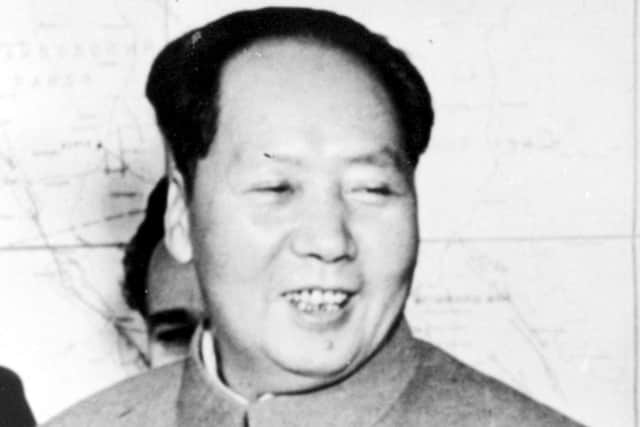
French football star Kylian Mbappe has issued a grovelling apology for describing Mao Zedong as a ‘dictator’.
Now Mao ruled China by decree for 27 years. He executed 800,000 people on the grounds he considered them ‘counter-revolutionary’. He forced millions out of their homes, and is widely acknowledged to have caused 10 million deaths. Streets were festooned with his portrait, and anything other than total devotion and loyalty to the ‘chairman’ was considered an act of treason. Elections weren’t really his bag, because who in their right mind would vote for all that?
All of which, I would suggest, makes him pretty much the dictionary definition of a dictator.
So why the apology? Well apparently, Mbappe’s statement cost him three lucrative sponsorship deals from Chinese companies. Principles come at a price, and it seems that Kylian Mbappe volunteered himself as a subject to a much more subtle form of Chinese tyranny, that of modern high finance.
Incidentally, Mao Zedong also executed about one million landowner on the grounds they were ‘landlords’ or rich peasants. I have a feeling the chairman wouldn’t have liked you much, Kylian.
Comment Guidelines
Iconic Media encourages reader discussion on our stories. User feedback, insights and back-and-forth exchanges add a rich layer of context to reporting. Please review our Community Guidelines before commenting.