
First Drive: Can Electric model cut it as a ‘true’ Range Rover?
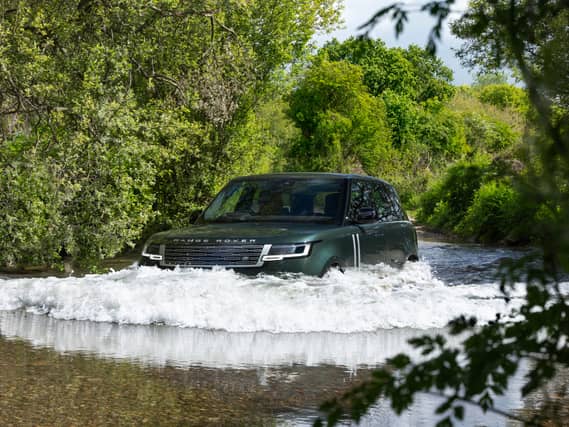

The new Range Rover Electric marks a turning point for JLR. Has it been a successful change, though? Jon Reay finds out.
What is it?
Turning the beloved Range Rover into an EV is no mean feat, of course. Naturally, it needs to do all the heavy-duty stuff Land Rover expects of its most expensive model – climb mountains, traverse rivers, gently massage you as you circle the A406, that sort of thing – but also, be able to drive a respectable number of miles without needing to be plugged in.
What’s new?
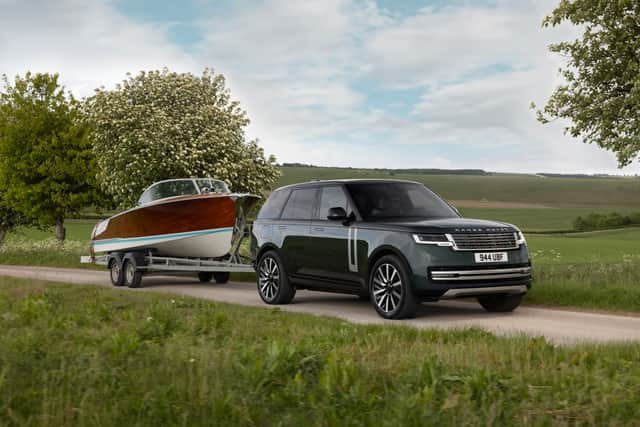
Fundamentally, this is exactly the same Range Rover that you’re able to buy with a petrol or diesel engine. Land Rover has simply found a way to tuck a big battery and two electric motors into its existing five-metre-long footprint.
The engineers are open about the fact this hasn’t been easy, mind. This generation of Range Rover may have been ‘designed from the start’ to accept an electric powertrain, but a big, brick-shaped SUV is still not the best starting point for a competitive EV in 2026.
What’s under the bonnet?
It’s partially these motors that have drawn out the development of the car for this long. It’s taken four years of testing to get to this final version, with one particular design of motor being abandoned at a late stage after it couldn’t meet Land Rover’s strenuous benchmarks – thus delaying things further.
Surprisingly too, Land Rover has designed its own motors, rather than buying some from another manufacturer, and even builds them in the UK at its shiny new Wolverhampton engine plant.
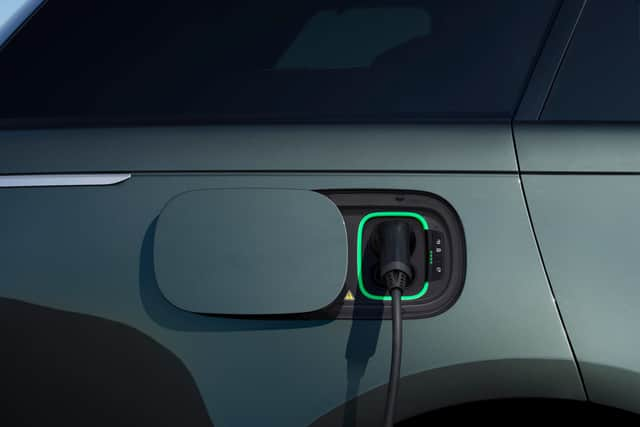
There’s just one battery option on offer too: a 118.5kWh pack with super speedy 800v architecture, meaning rapid charges of 10-80% in as little as 22 minutes.
Official WLTP range is 372 miles, and Land Rover tells us a sensible real-world range of around 330 miles is easily achievable. Not bad, though some way short of the 525-mile WLTP figure of the upcoming BMW iX5.
What’s it like to drive?
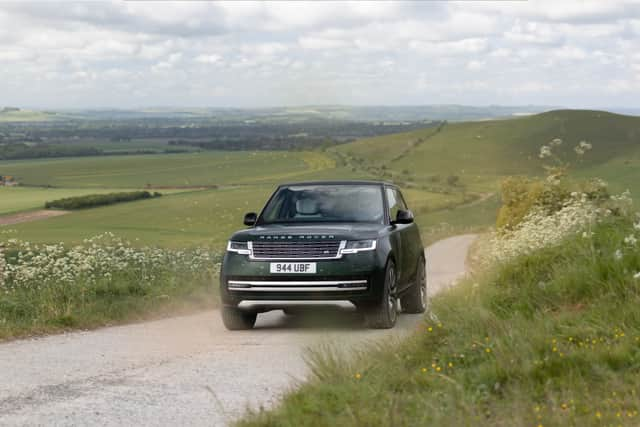
Although the body is the same as any other Range Rover, a few things have been changed under the skin to make sure this electric version drives properly too.
For starters, it’s been given fancier, twin-chamber air suspension to help deal with the additional weight of the simply enormous battery pack – though Land Rover says the Range Rover Electric’s lower centre of gravity helps it corner surprisingly well in the first place.
Then there’s the one-pedal driving mode, something new to Range Rovers. Land Rover has called this ‘chauffeur stop’, because it brings the car to a halt in a manner so delicate that you’d think a professional driver was behind the wheel. It really works, and it’s a feature you’d grow to miss after stepping into any other car.
It’s also, of course, extremely quiet. We didn’t get a hint of electric motor whine during our drive, and wind and road noise are as well suppressed as in any other Range Rover.
As for performance, this is now the quickest Range Rover you can buy in the UK – at least in terms of acceleration. 0-60 takes 4.3 seconds, edging out the petrol V8’s 4.5 seconds, and trouncing the diesel version’s 5.7 seconds.
Perhaps the most impressive thing of all is how the Range Rover Electric handles off-roading. One-pedal drive mode also works here, and has been calibrated to make tackling difficult terrain even easier than before. It’s simply a case of pointing the car at where you want to go, holding the accelerator pedal – and your nerve – and letting the electric motors work out the best way to get you there.
In fact, far from being pessimistic about EVs, Land Rover’s engineers reckon this is the best-performing Range Rover yet when it comes to off-roading – and after driving it, it’s easy to see why.
How does it look?
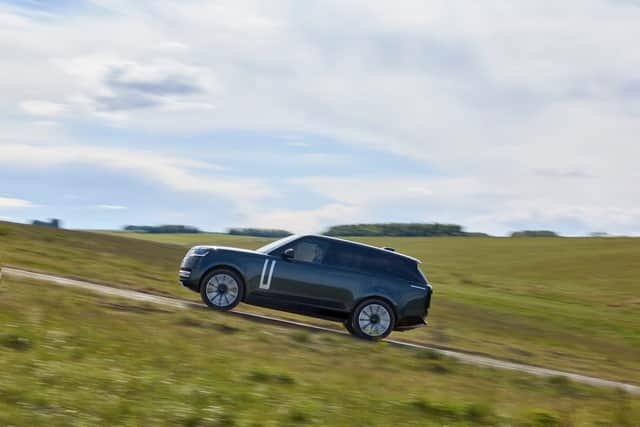
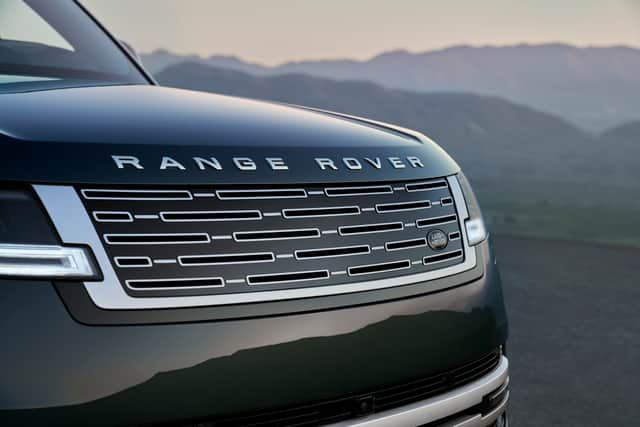
There are some very, very subtle differences, of course. The front grille is of a near-identical design to the conventionally-powered car, but is more blanked off for (mildly) improved aerodynamics.
The Electric gets its own selection of alloy wheel designs too, each similar to standard Range Rover ones, but subtly more aerodynamic. It’s here you’ll also find the only real hint of what powers the car: centre caps that instead of featuring the Land Rover logo, say ‘EV’.
What’s it like inside?
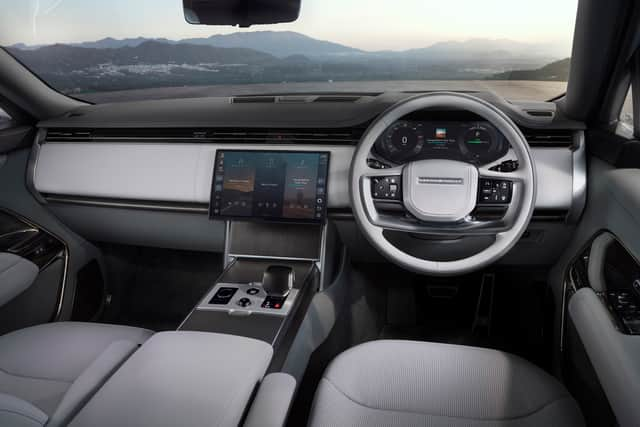
So, you can expect all the usual opulence of petrol and diesel Range Rovers, with no substantial changes to any of the materials and switchgear. Even more impressively, there’s no change whatsoever to the space inside. Land Rover has resisted the temptation to raise the floor a little for some additional battery capacity, or rob some boot space for that rear electric motor.
In short, it’s as plush and meticulously designed as ever – though we’d still like to see physical climate controls brought back from the 2022 model year version. Pretty please, Land Rover?
What’s the spec like?
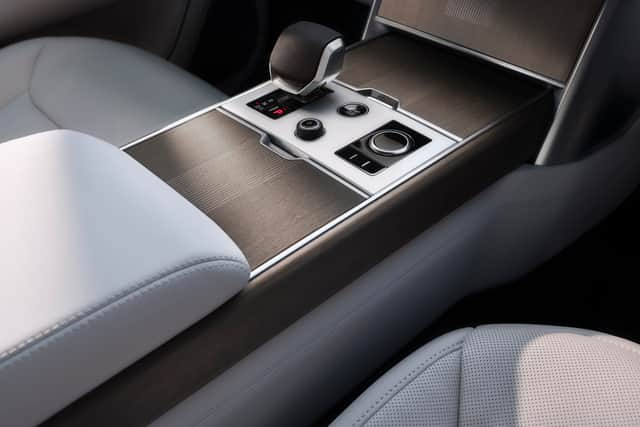
There’s not enough space here to list all the equipment on offer, but highlights are the usual upgraded Meridian sound system, panoramic roof, massaging front seats and electrically-reclining rear seats.
So much is bundled in that there aren’t many options left to tick, beyond more adjustment for rear seat passengers, and a pair of screens to keep them entertained.
Jump up to the SV version and things get even more opulent, with – in the long-wheelbase version at least – an electrically deployable fold-out table for rear passengers, a fridge in between them, and even some crystal glassware from which to enjoy their chilled beverages.
All of this comes at a price, of course: Range Rover Electric starts from a whopping £154,070 in ‘cheapest’ Autobiography trim. For comparison, that’s £26,000 more than a diesel Autobiography – or nearly £50,000 more than the entry-level diesel SE.
That’s rather a bitter pill to swallow – particularly when other markets, such as the USA and the rest of Europe, are also offered the Electric in more affordable trim levels.
Verdict
Even on our limited drive, it’s hard not to be impressed by the Range Rover Electric. On the face of it, it’s not the most competitive electric luxury SUV on the market – either in terms of battery size, performance or range. But that’s not really the point.
Land Rover has kept the spirit of the Range Rover fully intact, and actually improved on it in some areas. As a means of transporting people around in absolute comfort and luxury – particularly in an urban environment – it’s even better than the petrol and diesel versions.
However, it’s hard not to raise an eyebrow at the price tag. Land Rover will be hoping that many customers – such as those buying through a business – will be able to offset this against the tax benefits, but it’s still an eye-watering sum.
Regardless, for those that can make the sums work, the Range Rover Electric is a very impressive bit of kit, and may be enough to convince even the staunchest EV critics that the future doesn’t look so bad after all.